
TEXT AND PHOTOGRAPHS BY SHIVANGSHI MITRA
Gurgaon, Haryana, India
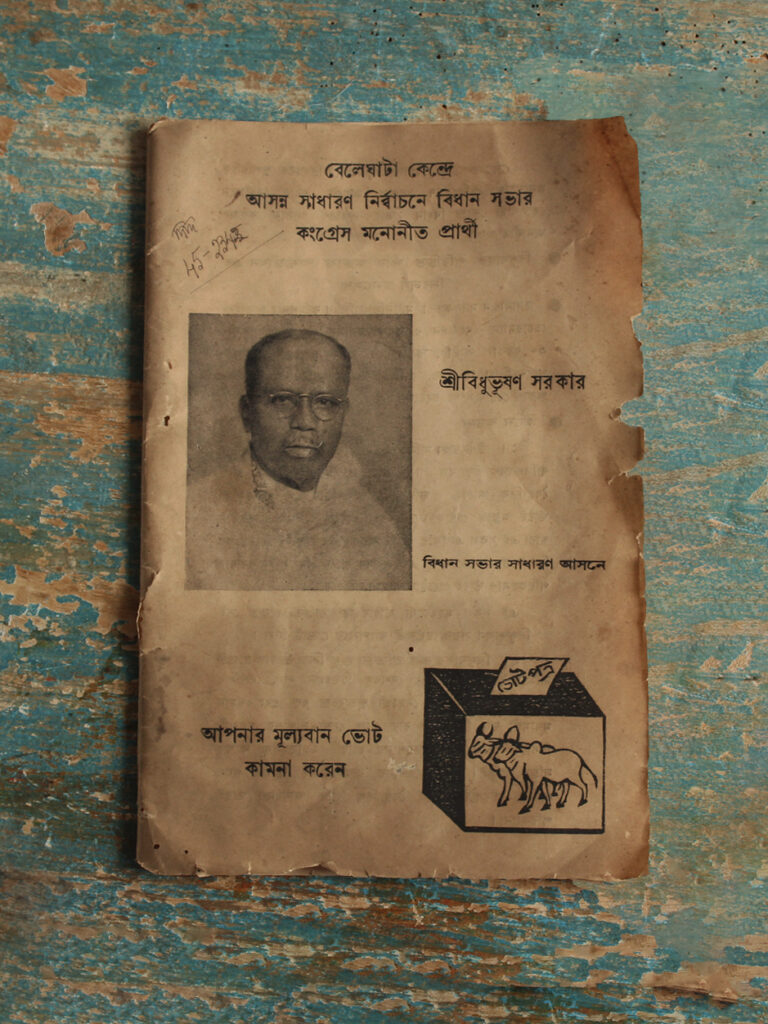
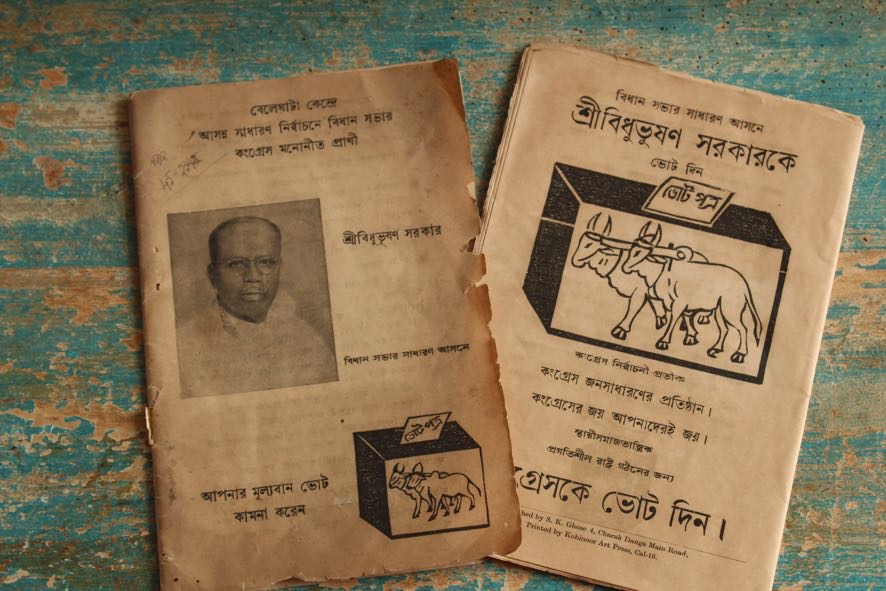
When my grandmother moved from her home in Loudon Street, Kolkata, to ours in Gurgaon in 2022, we chanced upon a yellowing leaf of paper from the past, buried deep in a drawer among other documents. This was my great-grandfather, Bidhu Bhushan Sarkar’s election pamphlet from the first State Legislative Assembly Elections held in 1952 in West Bengal, independent India.
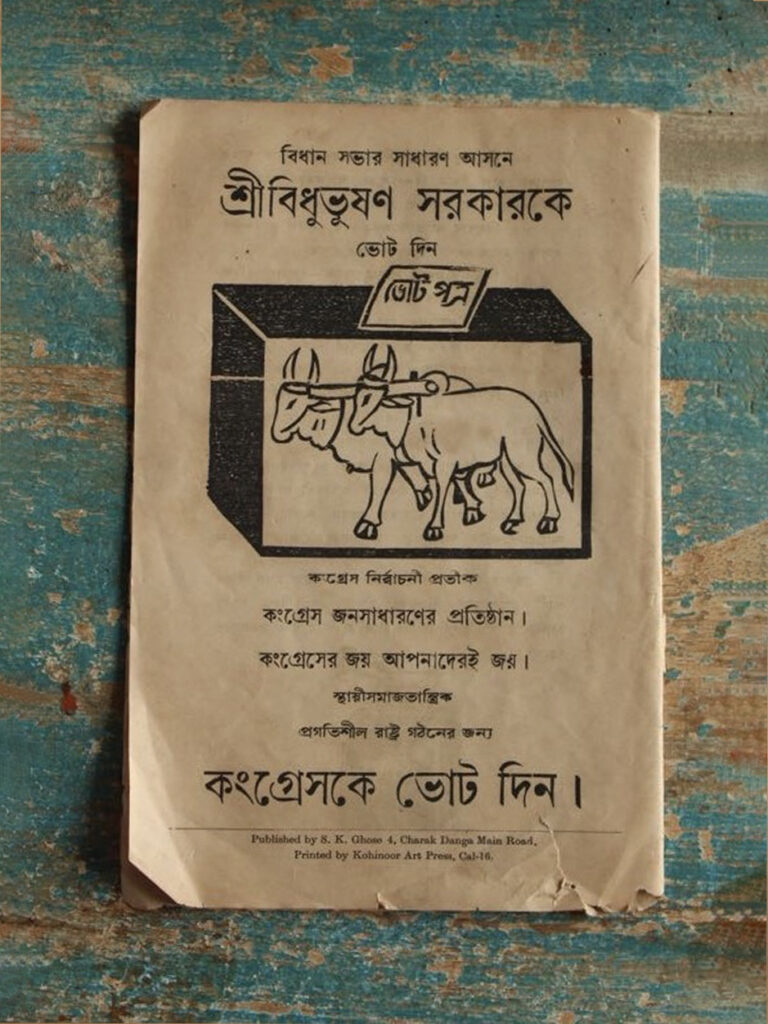
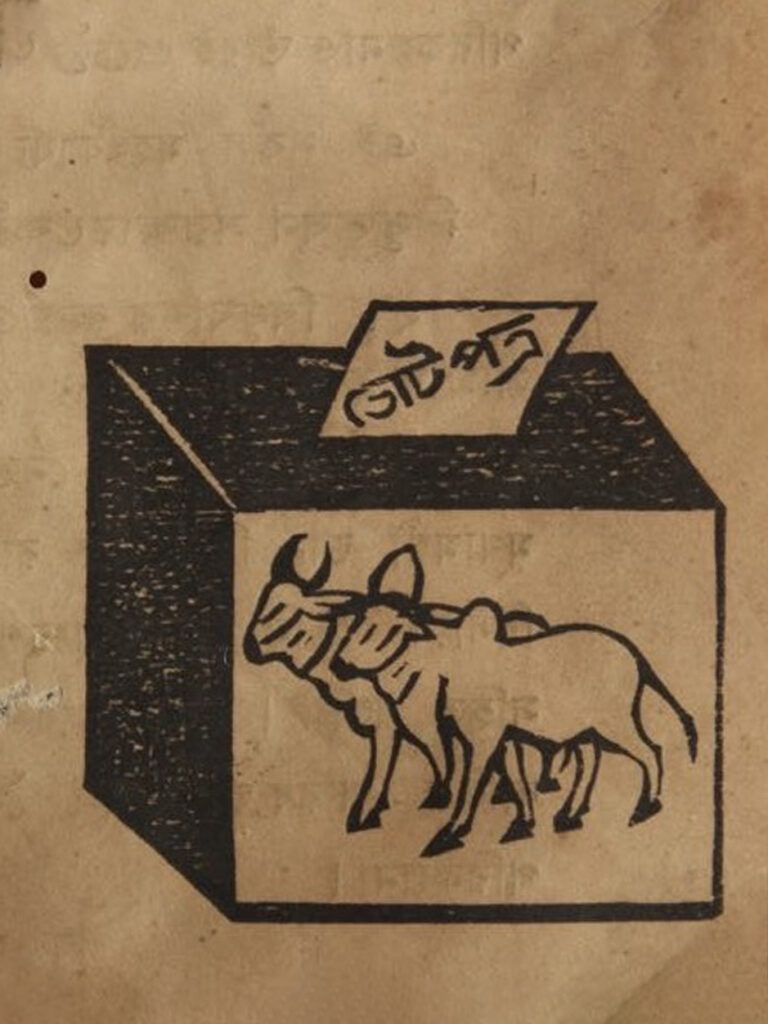
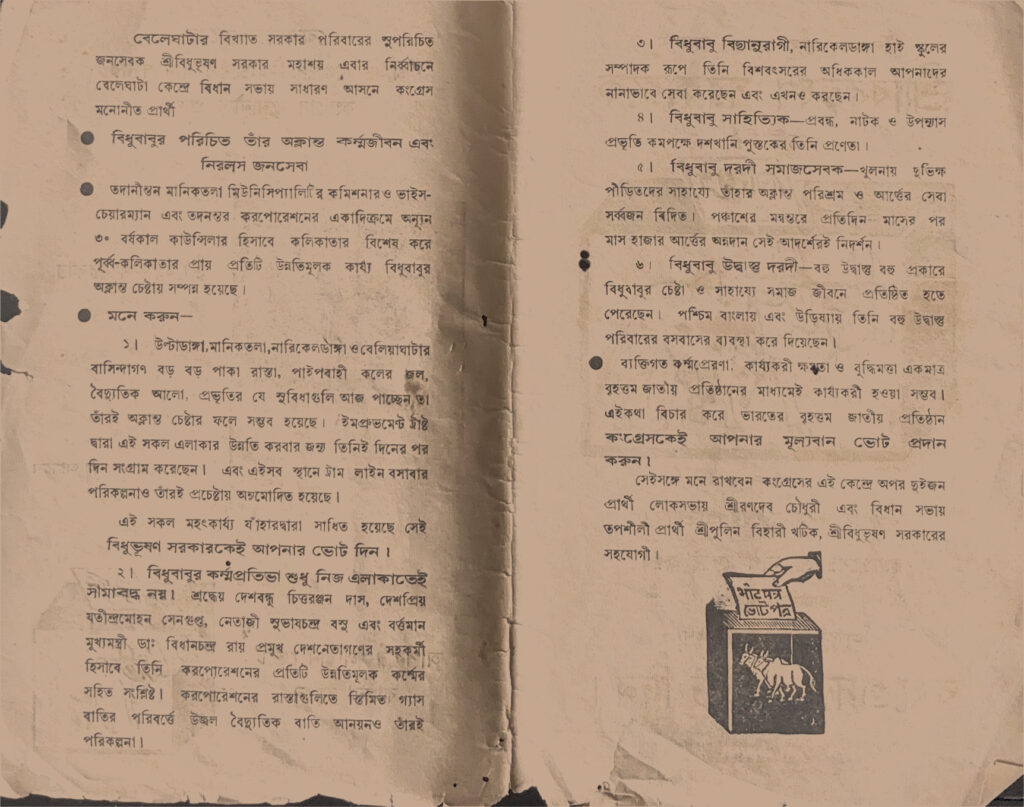
The thin paper had frayed with time. Each sheet of the pamphlet measured 21cm x 14cm, printed in black ink. Its surface bore small tears, brittle edges, and deep creases that suggested it had been folded many times. On its cover was printed the bespectacled photograph of a 62 year old Bidhu Bhushan Sarkar. It opened to densely printed Bengali text, outlining his campaign promises and achievements. The old Congress symbol of two yoked oxen stood boldly on the back cover and on a ballot box on the front cover. In the early 1950s, in the “overwhelming agrarian society of India, yoked oxen were commonly used to till farmland, preparing it to sow seeds.” At this time, the Congress party’s “clear focus on a socialist future for India was simply riding on the back of its farmers, much like the two oxen.”[i]
During that time, the Congress party was the dominant force but almost every constituency had influential and strong pockets of Communist presence, causing regular clashes over political influence. Both the Congress and the Communists were battling for supremacy in this constituency, which had a large number of refugees from East Pakistan, many of whom found ideological resonance with the left.[ii][iii][iv]
The nostalgia in finding these sepia stained sheets evoked in me a visceral response, so my father patiently sat and translated the pamphlet for my understanding. The pamphlet detailed his efforts to replace gas lights with electric street lights, to construct broad roads, and to supply piped water to neighbourhoods like Ultadanga, Maniktala, Narkeltala, and Beleghata. It spoke of his commitment to social and cultural development, his authorship of ten books, and his close association with leaders like Deshbandhu Chittaranjan Das, Subhash Chandra Bose, Bidhan Chandra Roy, and Jyotindra Mohan Sengupta. At the bottom, details of the printing press were recorded: Published by S.K. Ghosh, 4 Charak Danga Main Road. Printed by Kohinoor Art Press, Cal-16.
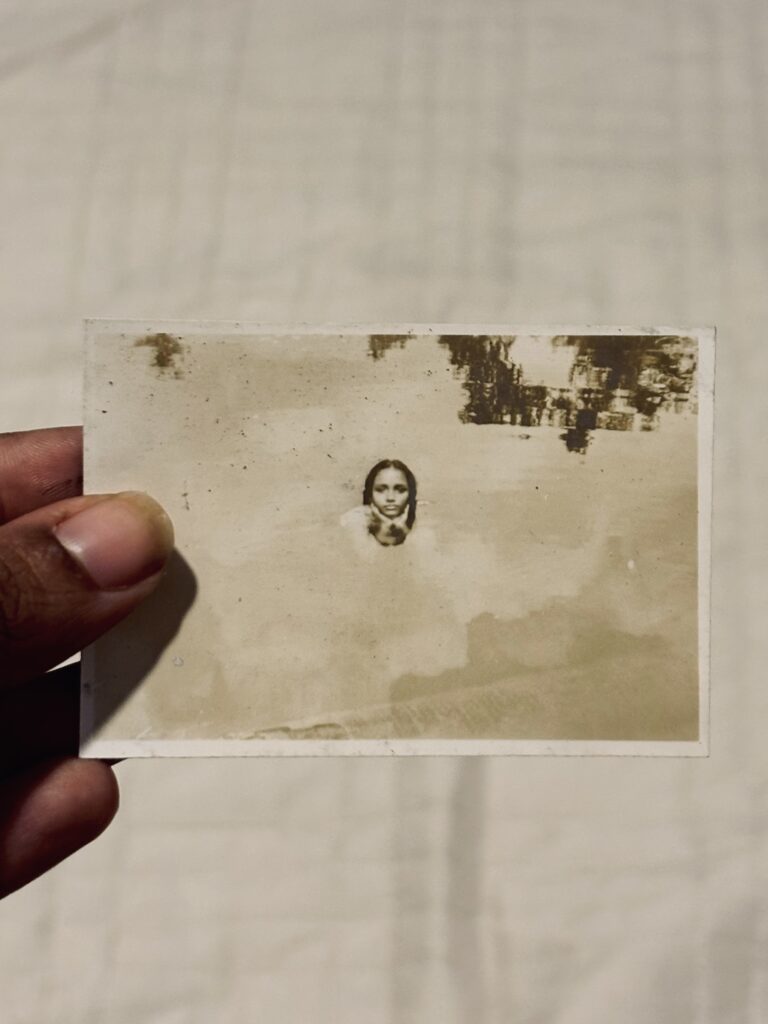
My great-grandfather, Bidhu Bhushan Sarkar, was born in 1890 and died in 1959. He had six sons and three daughters, one of whom was my grandmother. In keeping with those times, she shared a rather formal relationship with her father, despite being his favourite. In a move that was considered unusual by the standards of the conservative Bengali society of that time, he fought with his brothers and extended family to allow my grandmother to get her English honours degree in a Christian Missionary School (Loreto House, Calcutta). Later in the 1940s though, despite her gaining admission, he did not allow her to pursue a Master’s in English Literature from Balliol College, Oxford University, on the grounds that he would be unable to find a bridegroom for an overqualified daughter.
Bidhu Bhushan Sarkar had an imposing personality — he was a keen Congressman, an important leader, and a zamindar from an era now largely remembered through anecdotes. His ties to the Congress stretched back well before Independence, when he served as a Councillor in the Calcutta Corporation in the 1920s, [along with several family members], remained associated with the party well into the late 1990s. In fact, the local Congress office was housed in his ancestral home on Beleghata main road and was later succeeded by the local Trinamool Congress office, finally cutting the generational umbilical cord between my family and the Indian National Congress. In 1998, the last two family members still active in politics left the Congress to become founding members of the All India Trinamool Congress.
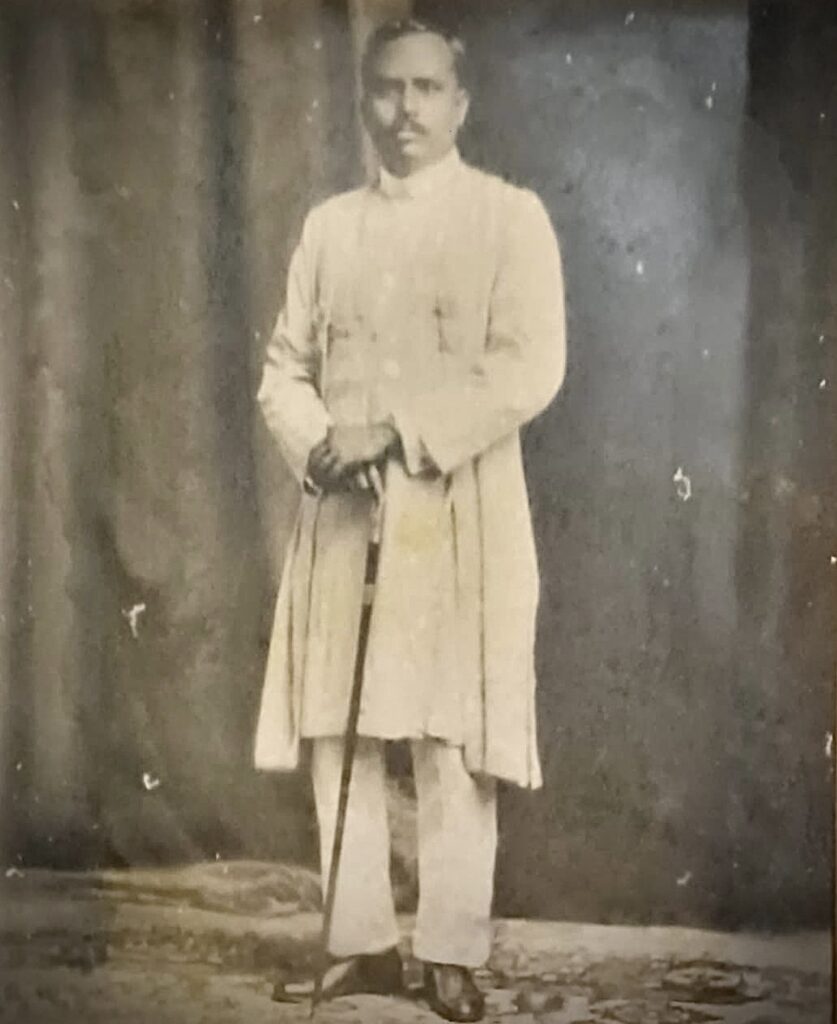
A contemporary and colleague of Netaji Subhash Chandra Bose, Bidhan Chandra Roy, and Shyama Prasad Mukherjee, Bidhu Bhushan Sarkar was fondly called “dada” by Netaji himself. In the aftermath of the Great Calcutta Killings, when Mahatma Gandhi visited the city, my great-grandfather hosted him in our ancestral home for a day-long stay, while his accommodation at Mian Bagan Basti was being prepared.
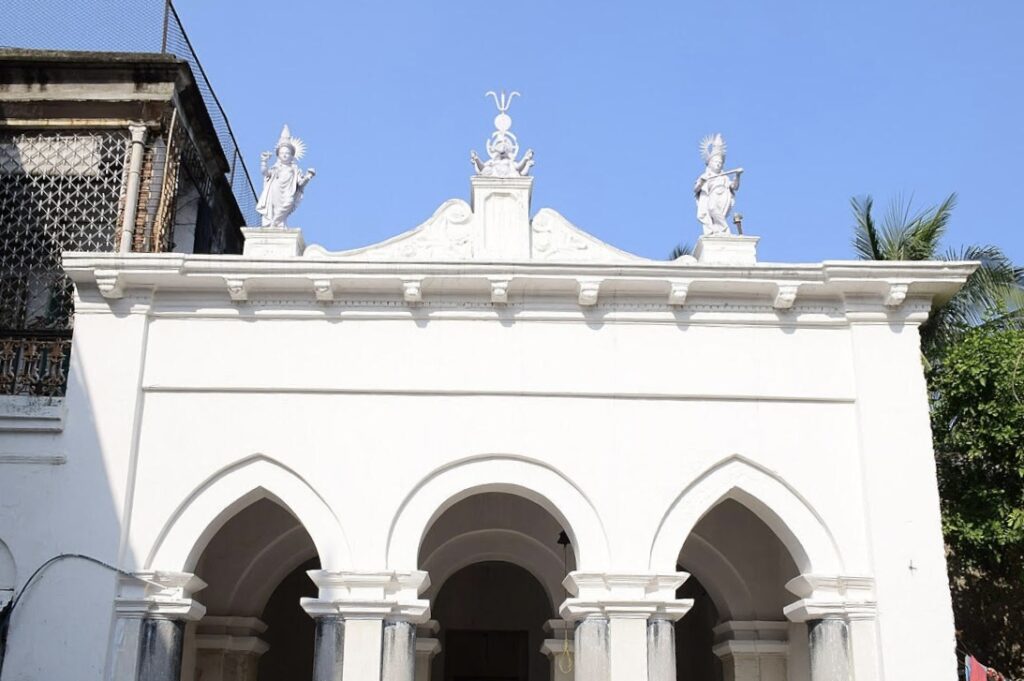
This ancestral house in Beleghata still stands and is one of the major historical sites in the area. Known as Sarkar Bari, the sprawling heritage mansion is over 130 years old, built in 1892 by Gagan Chandra Sarkar, father of Bidhu Bhushan Sarkar, who made his fortune in the fishery business. Stories of the home have trickled down the generations – like most homes of that era, it has a thakur dalan, where the annual family pujas would take place. An annexe, now demolished and built over, was once the jalsha ghar, where music and dance performances by well-known musicians and courtesans took place on festive occasions. I’m told that within the family, this annexe was called gaan bari, the music house, and stalwarts like Ustad Imdad Ali Khan, Ustad Alauddin Khan Saab, Gauhar Jaan and Ustaad Bade Ghulam Ali Khan have stayed and performed there. The home is set in massive grounds, with a two-acre private lake, on which family and guests used to go boating, swimming, and fishing.
Yet, even amidst this abundance and privilege, their life was not untouched by upheaval. The unholy rush of Partition, days drawn in blood that transcended all markers of society, caused the family to lose vast swathes of zamindari land in Khulna and Jessore, which now lay on the other side in East Pakistan. After Independence, however, Bidhu Bhushan Sarkar chose to meet the new nation with generosity rather than grievance: despite stiff resistance from his family, he offered one of his fisheries to the government to build Salt Lake City, without any compensation. Even today, the Kolkata Municipal Corporation’s main water pipe supplying the Beleghata area is called the BB Sarkar Mains, for he personally paid for it.

Despite winning all his Corporation Elections, he lost the Assembly Election for which this pamphlet was printed. My grandmother is the only surviving member of her generation, and she recalled that her father and the entire family were very disappointed as he was a pre-poll favourite to win, but the polling agents had underestimated the influence of the Communist Party among the masses.
Still, the pamphlet survives as a relic of an era of optimism, faith in democracy, and the birth of independent India. For me, holding it in my hands was surreal. Though I never met my great-grandfather, I had often heard my grandmother’s riveting stories of her father’s heydays, told with the tenderness of a daughter who had been the apple of his eye. Seeing his legacy embodied in this fragile sheet of paper was different from hearing anecdotes – it was history, folded and creased, yet alive in my hands.
This pamphlet, tucked away for decades, has now bridged generations – from a leader and Congressman, to his daughter who remembered both his power and his losses, and finally to me, his great-granddaughter, for whom this object became a tangible portal into both family history and the political history of Bengal.
[i] Joanna Banerjee-Fischer, What do India’s political logos symbolize?, January 27, 2024 https://www.dw.com/en/what-do-indias-political-logos-symbolize/a-68095324
[ii] Milinda Banerjee, Partition, Bengali Refugee Critiques of Postcolonial State and Capitalism, and the Subaltern Origins of the Cold War in India, 1947–1950, The Historical Journal (2025), 68, Cambridge University Press, pp. 724, 729 https://www.cambridge.org/core/services/aop-cambridge-core/content/view/748468820C522991CD5F8FE9BB165534/S0018246X24000712a.pdf/partition_bengali_refugee_critiques_of_postcolonial_state_and_capitalism_and_the_subaltern_origins_of_the_cold_war_in_india_19471950.pdf)
[iii] Anwesha Sengupta, “They must have to go therefore, elsewhere”: Mapping the Many Displacements of Bengali Hindu Refugees from East Pakistan, 1947 to 1960s, Public Arguments, Publication: 2017, Tata Institute of Social Sciences Patna Centre, pp.8 https://tiss.ac.in/uploads/files/PublicArgumentsSeries2.pdf
[iv] https://www.sahapedia.org/refugee-colonies-kolkata-history-politics-and-memory