
TEXT BY SUMEDHA RAIKAR MHATRE
PHOTOGRAPHS BY MAYUR DHADWE & MANGESH PANAVKAR
Mumbai, Maharashtra, India
I liked the word chinchpeti before I knew I would inhabit the world of words. In my schoolgirl years, it reached me in a half-hush through Aai, “Aaji has kept this for you.” The word tickled me: chinch. peti. A conjuction that poetically marries chinch, the humble tamarind seed, seen in the tiny pearl droplets, and peti, the sturdy, box-like gem panels that frame them. There is an inherent magic in how Marathi grounds beauty in the everyday natural world, anchoring elegance to craftsmanship.
Molesworth’s 1857 Marathi-English dictionary records chinchpeti/chinchpati. What strikes me is the historical context: Molesworth, assisted by George and Thomas Candy, compiled the dictionary for the government, drawing on both texts and living speech- even words heard in the street. They were not simply matching equivalents; the work paid attention to the differences between Marathi and English idiom. It feels wonderful to find chinchpeti in that nineteenth-century net. The Maharashtra Shabdakosh describes it as tamarind-leaf-shaped petya and pearls. In my copy of the later Chaus dictionary, I cannot find the word, which surprises me because I usually find Chaus so alert to local usage. Dictionaries are great companions; comparing them can be a small sport.
My chinchpeti was made in Gwalior around 1968, the year I was born, and commissioned by my maternal Aaji, Shantabai Gadgil, from a local jeweller. I had spent four years in that maternal household in Gwalior, so this was never an abstract inheritance. My mother and maushi were already married, while Aaji’s two sons were approaching marriage. Aaji was haushi in the best Marathi sense: energetic, interested, always keen on traditional dress and jewellery, and eager to add different old designs to her collection, many of which she would eventually pass on. In a way, she introduced me to that aesthetic long before I knew to call it one.

Navdha MalhotranmalhotraEdit Profile
Aaji was born in 1914 into the Karnataka-rooted Barve family, married into the Gadgils, and made her life in Gwalior. The jeweller’s name is no longer remembered. My maami, the only surviving member of that generation, has only a faint recollection of the choker, a realisation that came to me recently, when I began asking where it all began. Tracing its history with whatever family memory remains has itself been an education.
My chinchpeti belongs to an earlier, quieter design vocabulary, simpler than the bright, dangling chinchpetis one sees today. Somehow the word opens a jewellery box of Marathi for me: Thushi, another close-neck choker of tightly packed little beads, forever bringing to mind what we called a little Thama Kaku, the girl at a wedding already carrying herself with aunt-like confidence, suitably thushi-clad; then tode, those substantial bangles, with the Shindeshahi toda carrying enough heft for me to hear a Sunny Deol hathoda thump; patlya, the broad bangles that sit naturally with the green glass ones; vaaki, worn high on the arm; bormaal, whose beads take their name from the little bor [jujube] fruit; chandrahaar, a necklace of linked gold rings; chaplahaar, of flat, coin-like forms; pohehaar, whose delicate shapes recall pohe [flattened rice]; and ekdani, a single strand of rounded beads. Tanmani is another word that has always held me: a diamond-and-pearl neck ornament, its dictionary root giving tanu [beautiful] + mani [jewel]. These are not just names. The vocabulary itself is a gateway to an aesthetic. Thinking in Marathi always brings a clarity and texture to my thoughts, bridging the distance between the language, the ornament, and the aaji who wore it before me.
The attested Marathi jewellery terms have always attracted me, be it a saaz, with its many small pendants, or a ganthan, the black-beaded marriage necklace with twin vatis. Some I now possess, bought or inherited; others I see worn regularly by women close to me. The words seem like worlds in themselves, so exact for the objects they name. As a child admiring them, of course I did not know that Marathi, and its English interpretation, would become central to my culture beat as a journalist and culture columnist. That bilingual correlation has also run through my office work and my stories. Nor did I know that I would one day explore Marathi’s vocabulary, texture and rhotic roll of its every day rhythm.
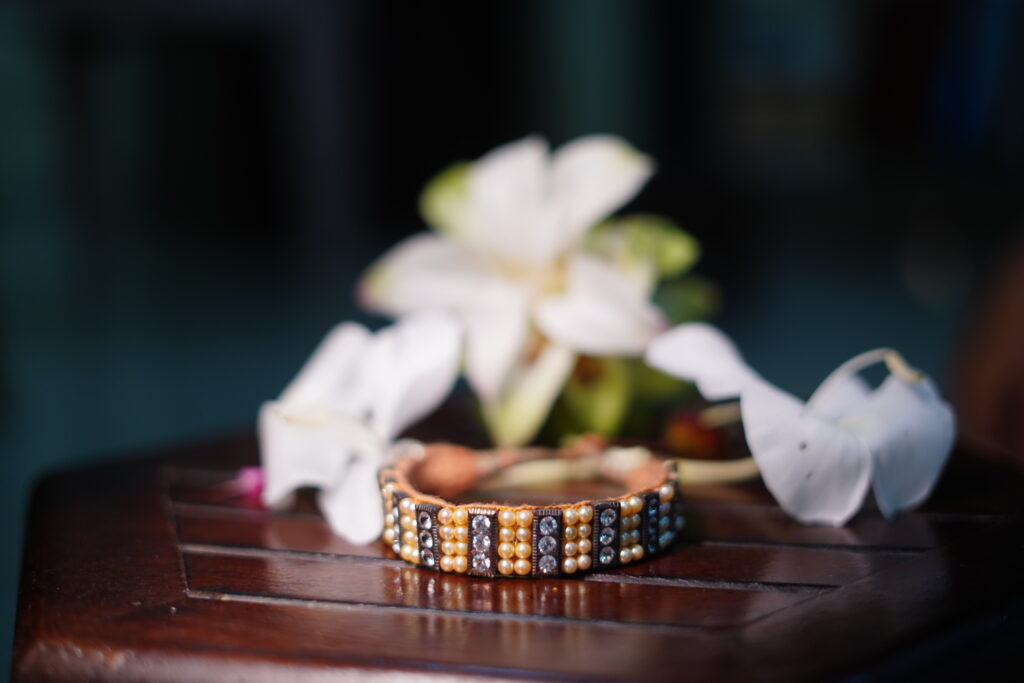
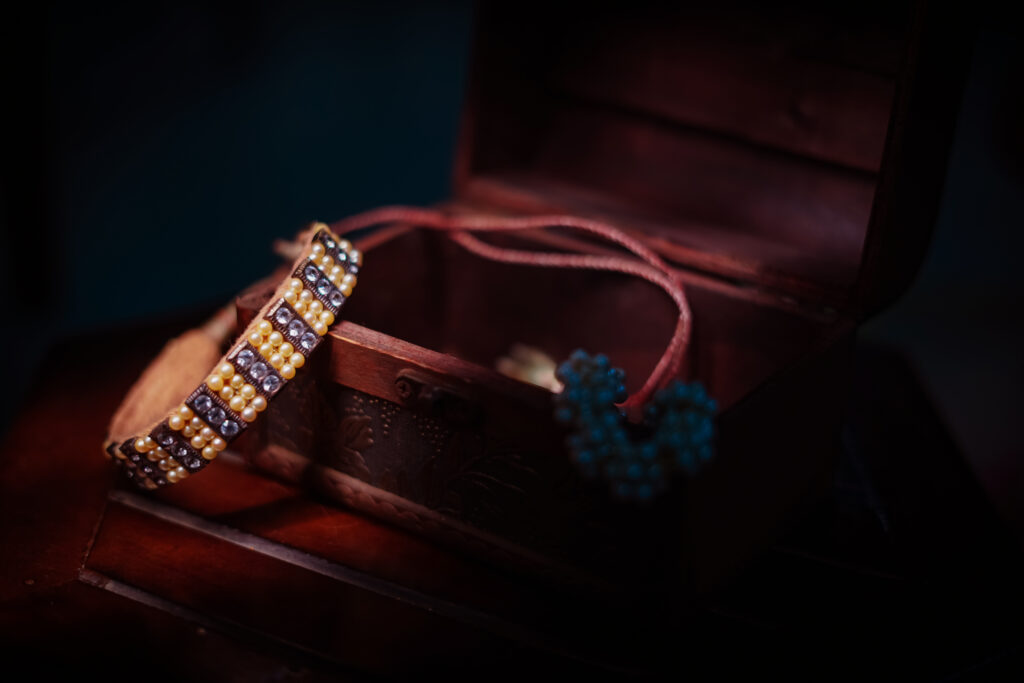
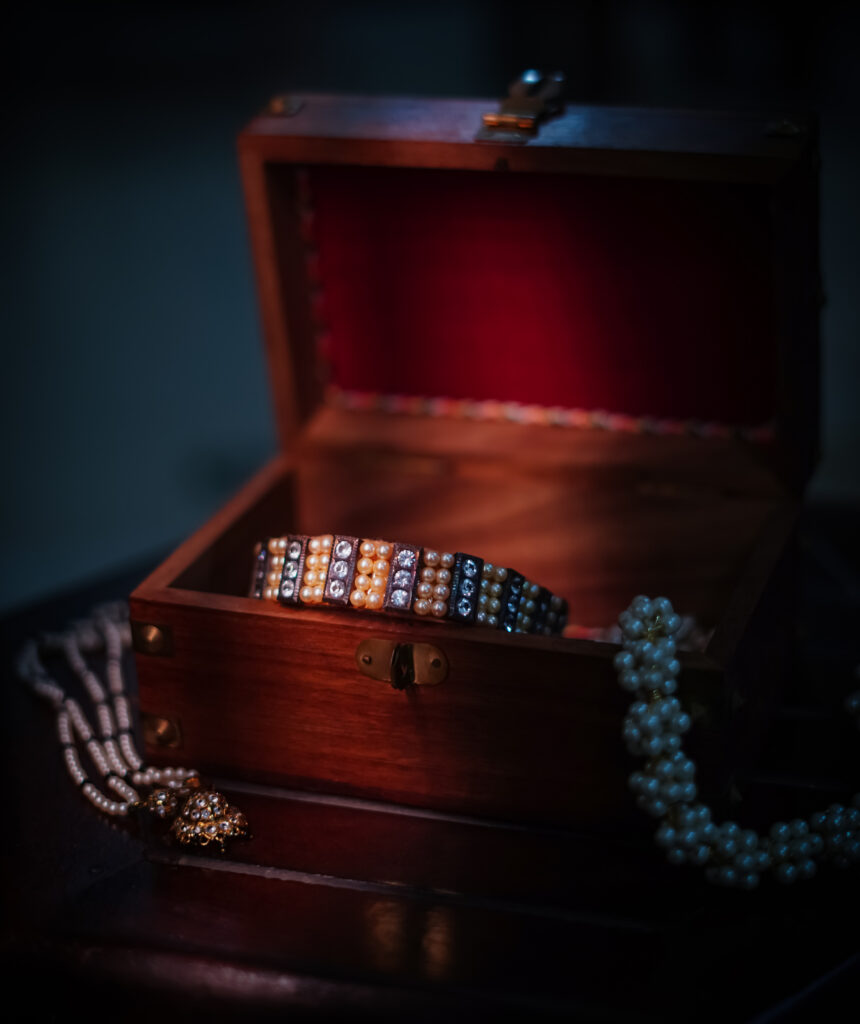
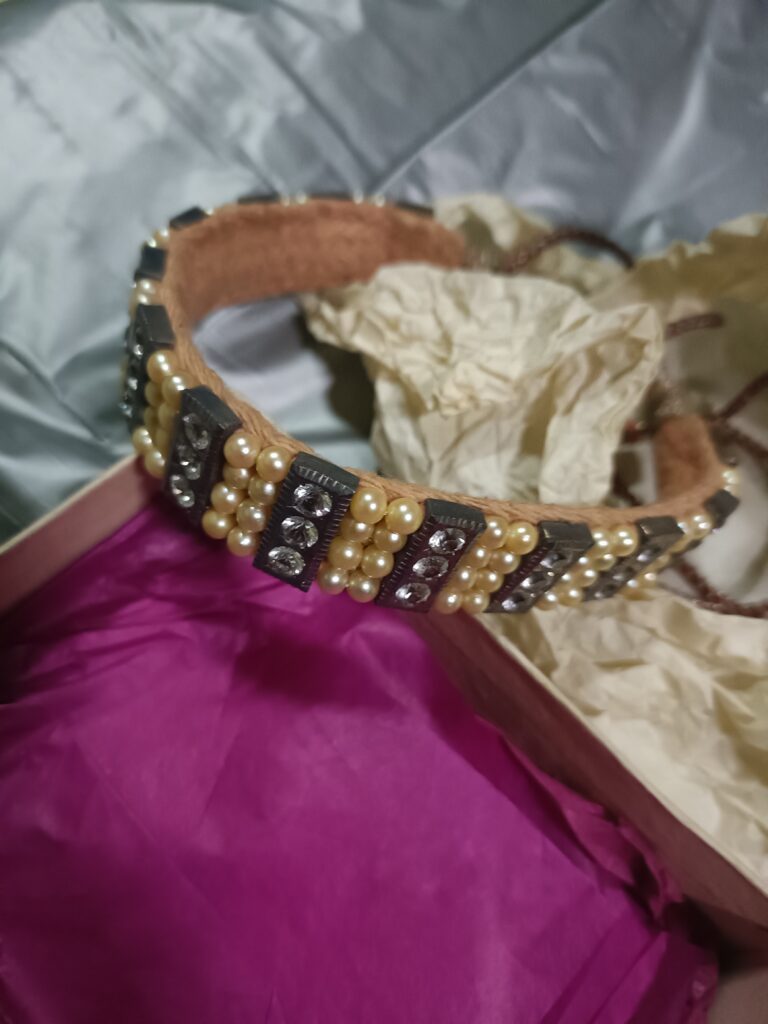
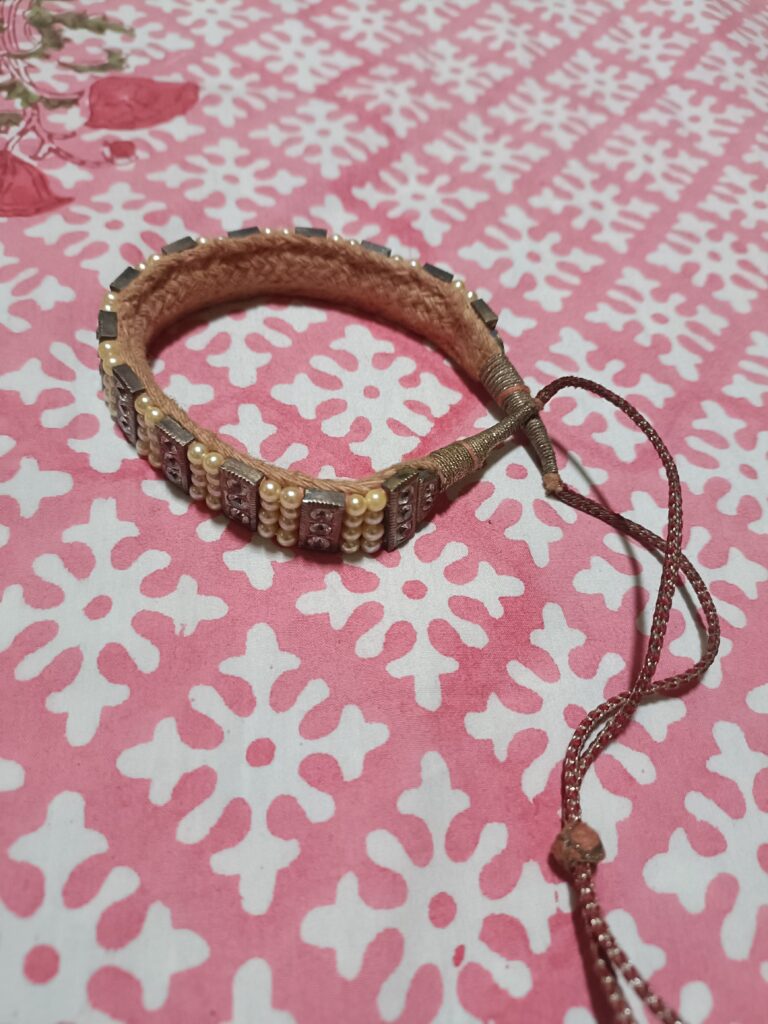
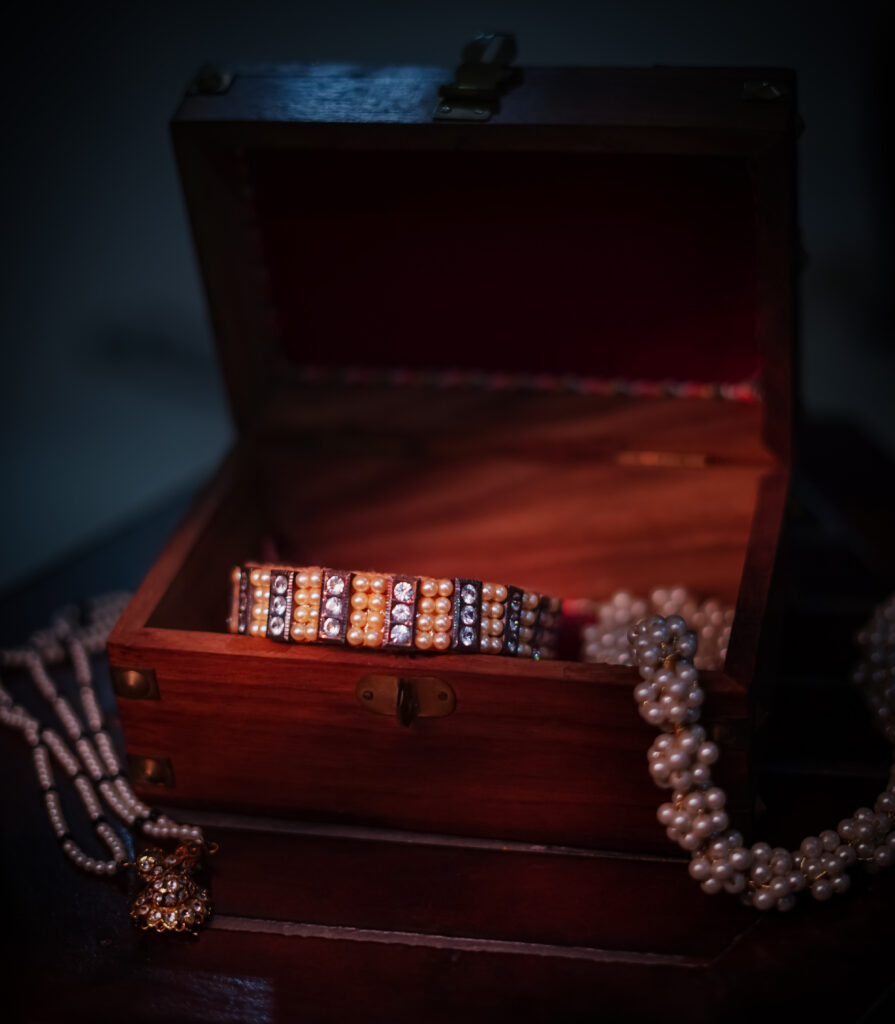
The word came first. Now it leads me to the object. The chinchpeti is surprisingly petite. About 10 inches long and under 25 grams, it sits easily in my palm. Its small metal sections hold clear stones and tiny pearls. Turn it over and age shows more readily: the fabric backing has faded to a light orange, the threads have worn, and even the crumpled reddish-pink paper in which it has long been wrapped seems to belong to it now. I had it polished a few years ago; otherwise, I have left it as it is.
Long before the chinchpeti came into my hands, I kept hearing versions of: Aaji has kept this for you. In my mother’s Kokanastha Brahmin family, who would eventually get which ornament or household treasure was a small but persistent family dynamic, part affection, part negotiation, part good old family talk. I had spent four years in that maternal household in Gwalior, so these were never abstract inheritances. Even before an object changed hands, there was already a story around it.
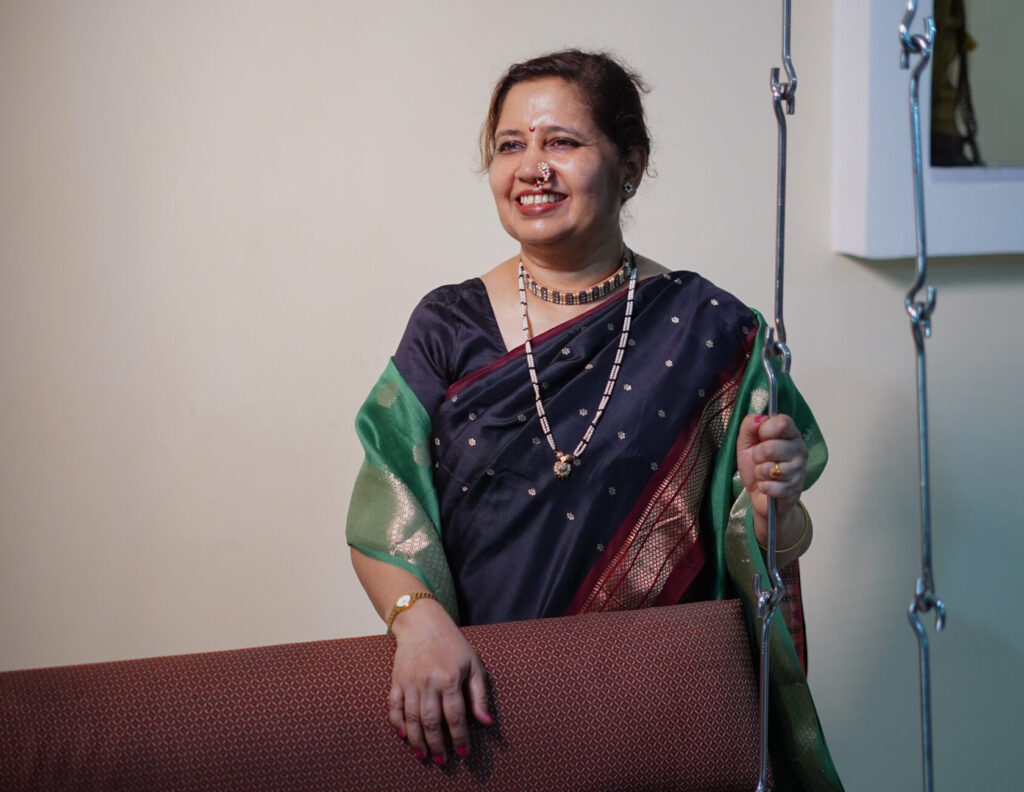
I distinctly remember the chinchpeti traveling with Aaji from Gwalior to Mumbai and then Pune, disappearing into lockers, coming out again for occasions, and being worn by other women in the family. By the time Aaji was living in Pune, she had passed the chinchpeti to Aai, who later gave it to me. It was among the most petite pieces in her jewelry collection, and certainly not the costliest. Yet I was always curious about it, and so was Aai; she was pleased when it came to her. Aaji died in December 1996; I married in January 1997, only a month later. Aai and I returned to this chinchpeti conversation many times before she died in 2004.
I have never thought much about what the chinchpeti might fetch, nor had the stones or pearls tested or valued. Its worth has always sat elsewhere. It brings Aaji back, but not in a tidy, sentimental way. It brings her back through the time we did spend together, but also through the sense, clearer to me now as I age, that there could have been more of it. There is also that impossible wish with someone no longer here: give me one scene again and I might do it differently. Old objects can do that. They return affection along with the small things one wishes one had done differently.
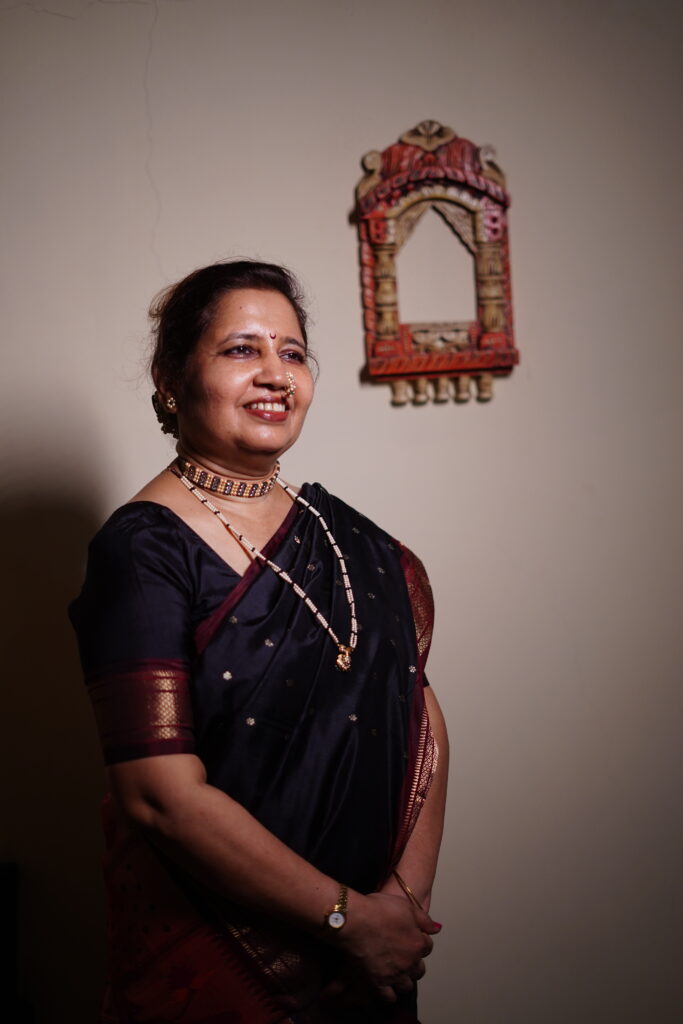
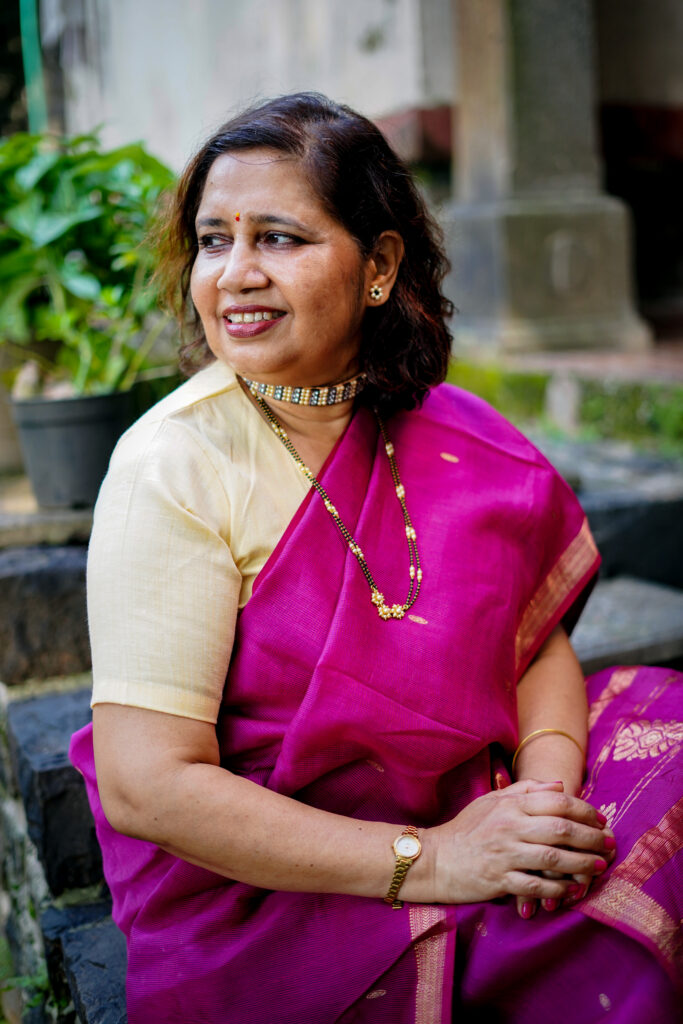
I keep the chinchpeti in my home locker and wear it occasionally, especially around festivals. It sits close to the neck, almost like a tight hasli. A long neck may show it off best, but mine is neither particularly long nor short, and I am quite at ease with that now. I have lines on my neck too, something I was once more conscious of than I am today. Today, wearing the chinchpeti is also a small act of accepting the body that has travelled this far with me.
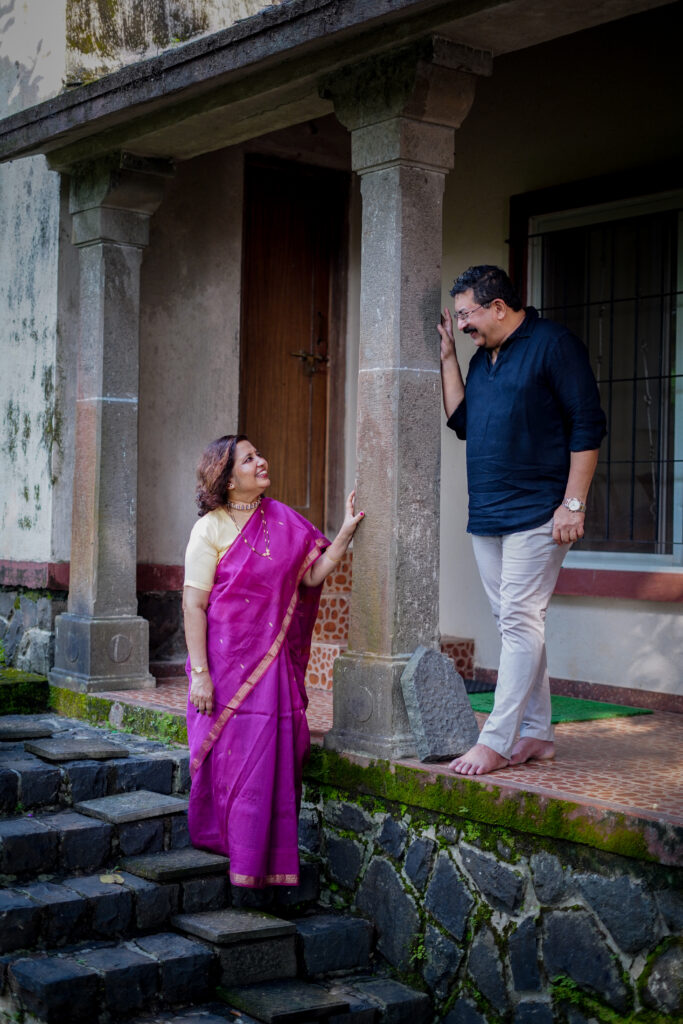
I still have a weakness for funky contemporary brass jewelry. I also feel silver jewelry suits my office avatar and Mumbai pace. But when Ganpati Bappa comes home, festive dressing pulls me towards what has lasted. Ganesh Chaturthi is a big occasion in the Vaishya Vani household I married into, in Wada, Palghar district, and when I wear the chinchpeti, the women around me often notice how well it has survived. Some rue that their own heirlooms, especially old sarees, did not. That usually sets me off on my familiar favourite subject: old sarees. In fact, I am the visiting relative dispensing my two cents on storing, preserving and not giving away too quickly. Aai and I shared this weakness; both of us had to school our faces when a younger woman announced that a wedding saree was discarded or fashioned into a kurta or dress. Up-cycling has its logic, but I derive a peculiar sense of pride, even power, from an old saree remaining an old saree.
In a large joint family in Wada, this little choker often starts another round of conversation on sarees and hand-me-down heirlooms. The chinchpeti gets a life each time I wear it. It leaves the locker, sits around my neck, and becomes present tense again… And for that moment, the chinchpeti brings Shantabai Gadgil back into the room. Among a lively, high-energy circle of women, she would have had plenty to say and happily talked the day away.