
TEXT AND PHOTOGRAPHS BY AYISHA ROSHAN MOHAMED
Chennai, Tamil Nadu, India
On the old wooden shelf in my grandfather’s home in Madras (now Chennai) sits a small red and yellow tin coin bank, quiet, rusted, and unassuming, but to me, it has always felt alive. My grandfather, Divan Mohideen, bought it in 1968, when he was 22 years old, long before my mother or her siblings were born. Through all the years that followed, with moving houses, growing children, and the noise of everyday life, this coin bank has never left his side.
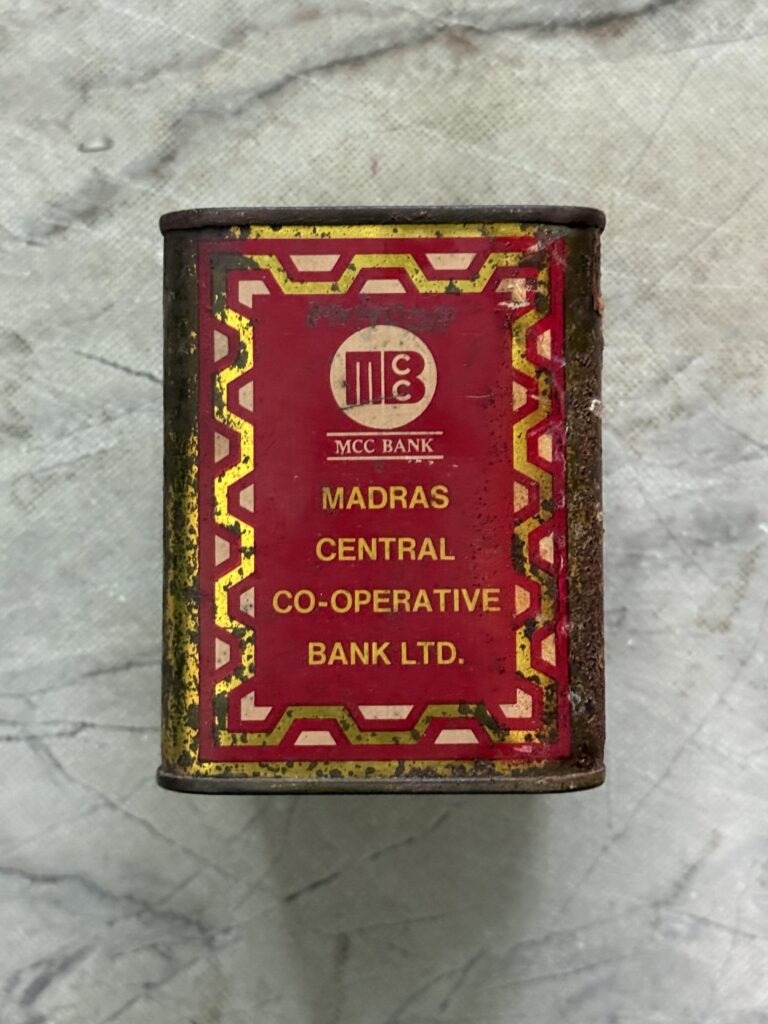
It came from the Madras Central Co-operative Bank Ltd., one of the oldest banks in the city, its roots reaching back to the 1930s, when Madras was still under British rule. The British had a curious habit – banks in London often gave small metal coin boxes to families, especially children, to teach them thrift and discipline. That same tradition found its way here, to the households of Madras. Even decades later, the idea remained in Chennai, where the textile shop, Pothys used to give small metal coin banks to children, and I have fond memories of receiving one myself around 2005–2006. Perhaps that is what makes this little tin so special. It carries traces of two worlds, the colonial and the Indian – conjoined in metal and paint.
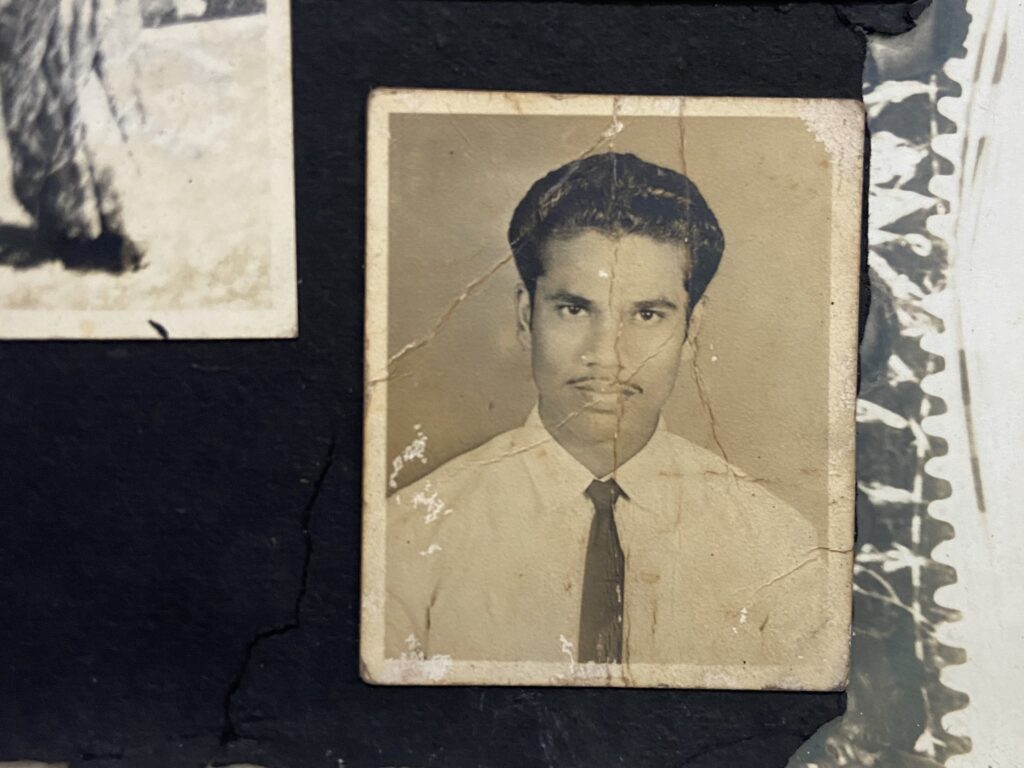
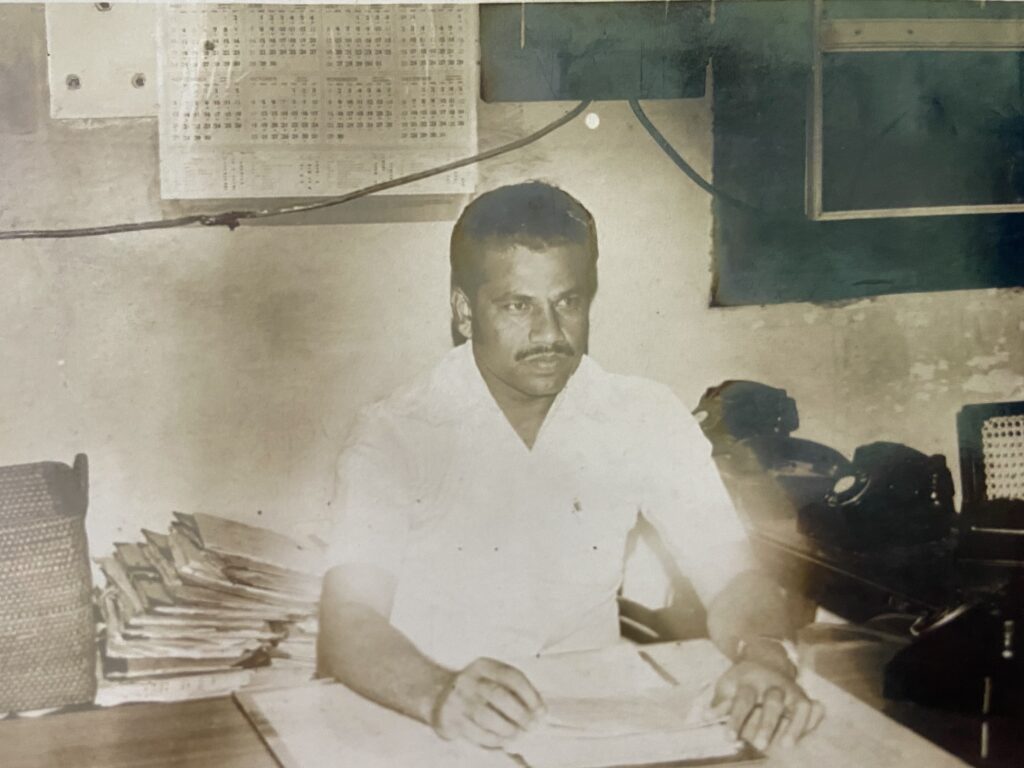
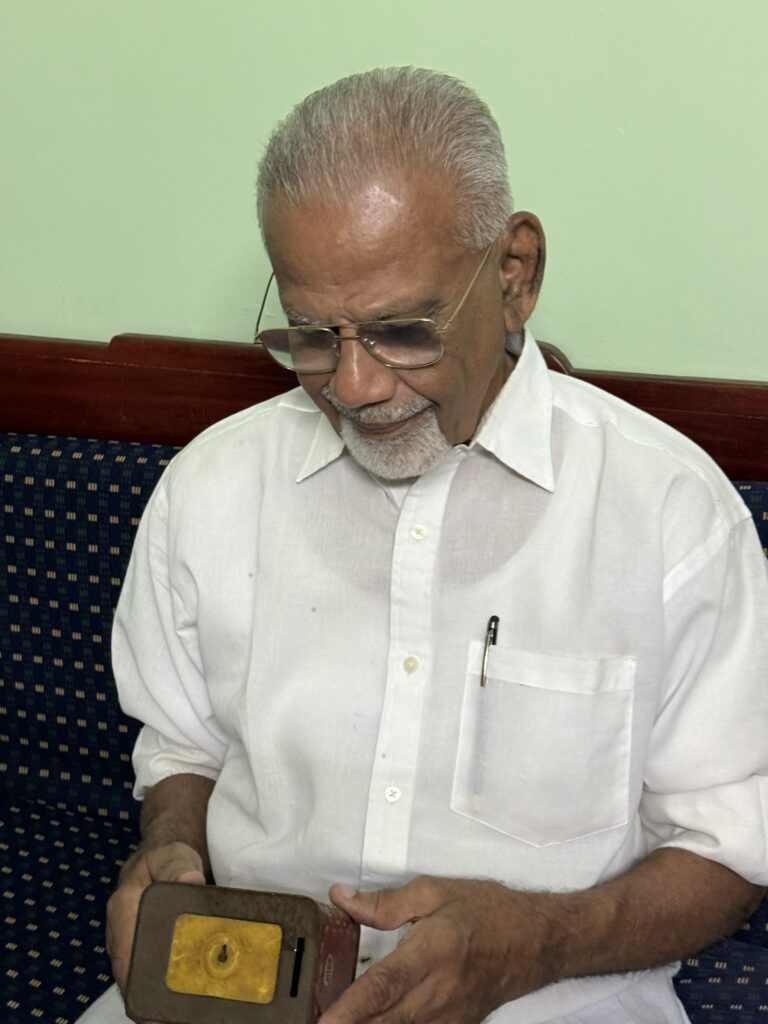
My grandfather was born in Madras in 1946 and worked in the Southern Indian Railways as Chief B.T. Controller. He is a man who believes in saving, in care, and in the patient building of things. He once told me that he bought the coin bank not just for money but for hope. “Each coin,” he said, “is a small dream waiting for its turn.” He would drop coins through the slot whenever he had loose change, the sound soft but certain, echoing faintly through the afternoons of his home. He often put multiple coins at a time, never just one.
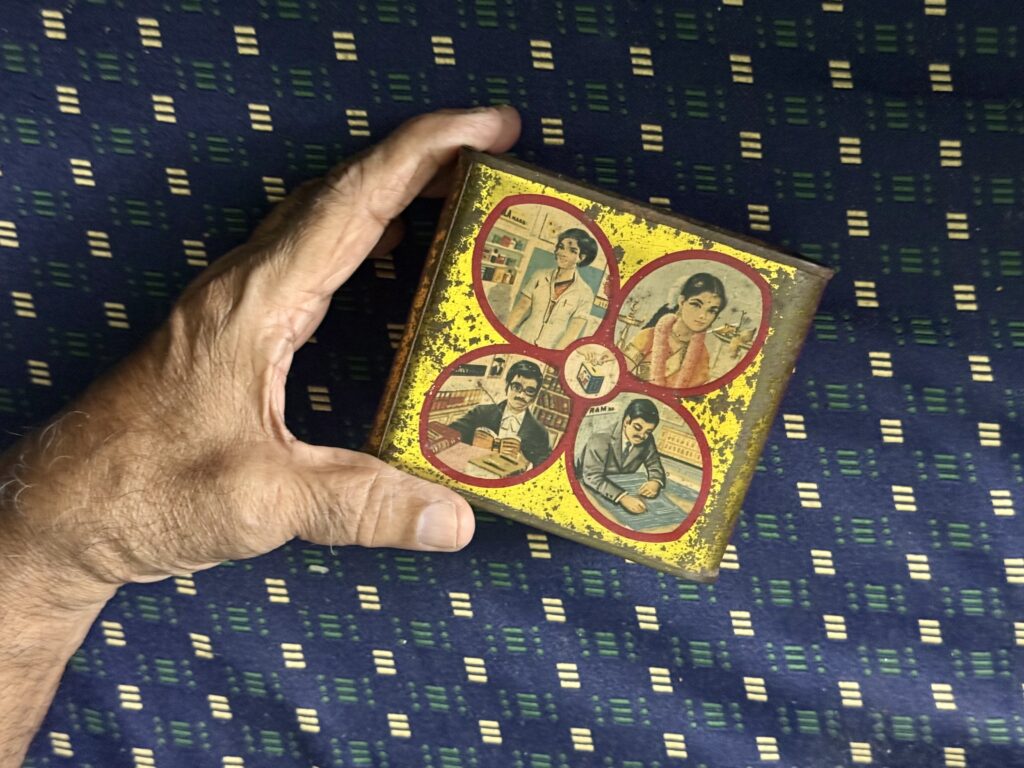
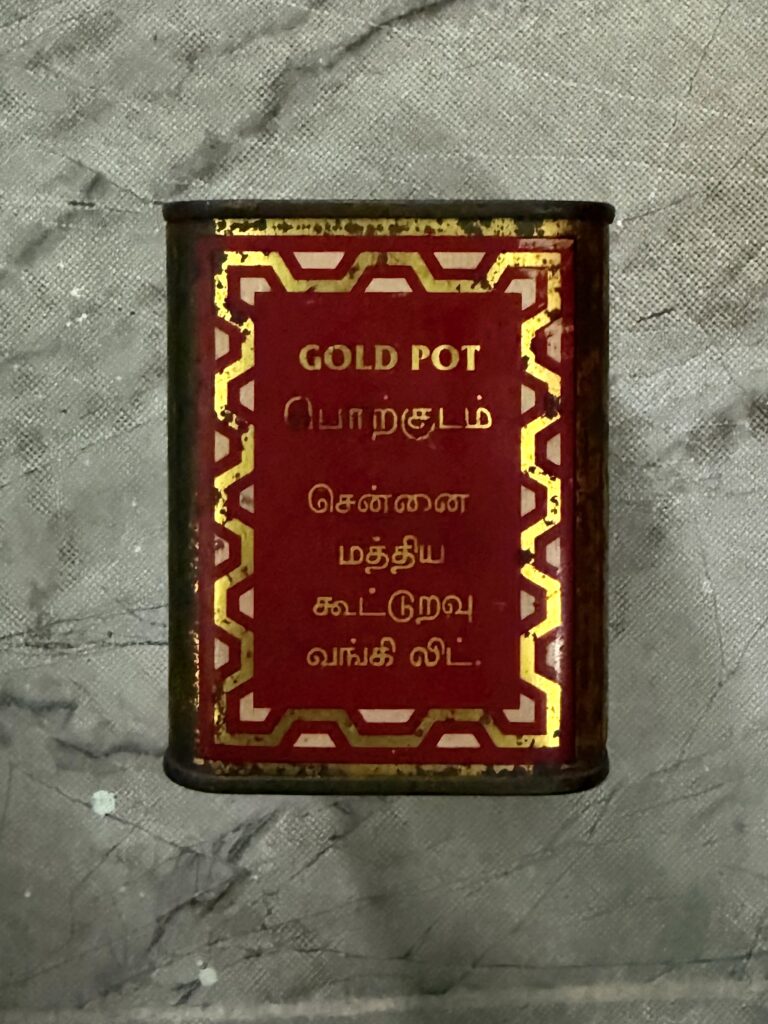
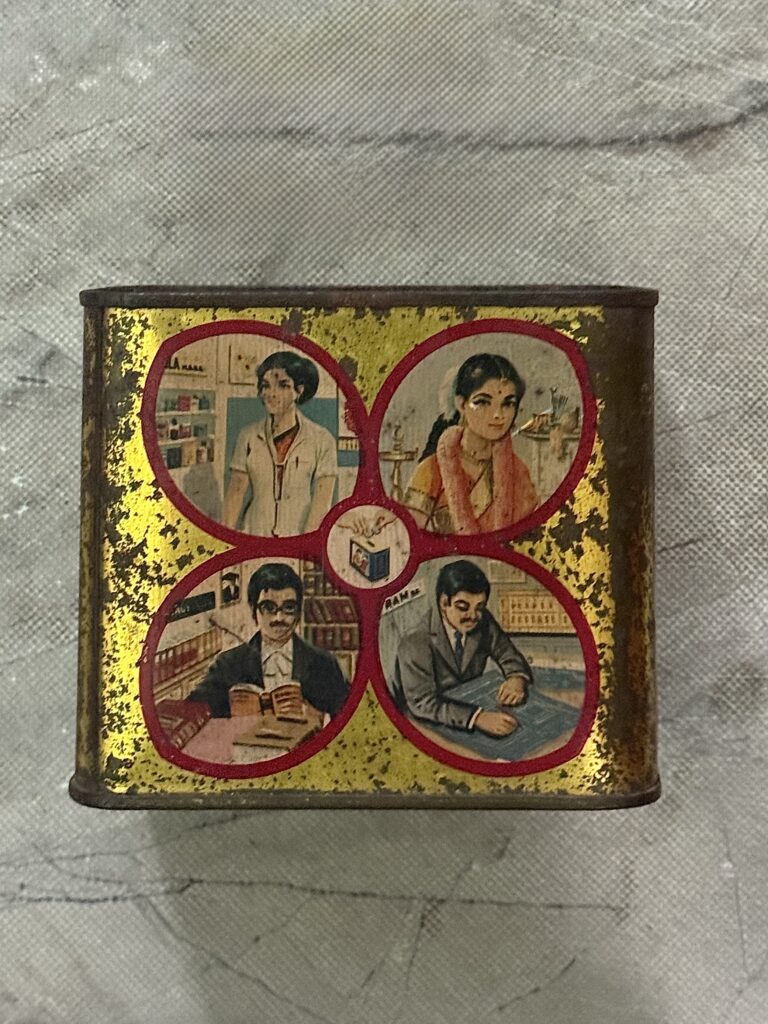
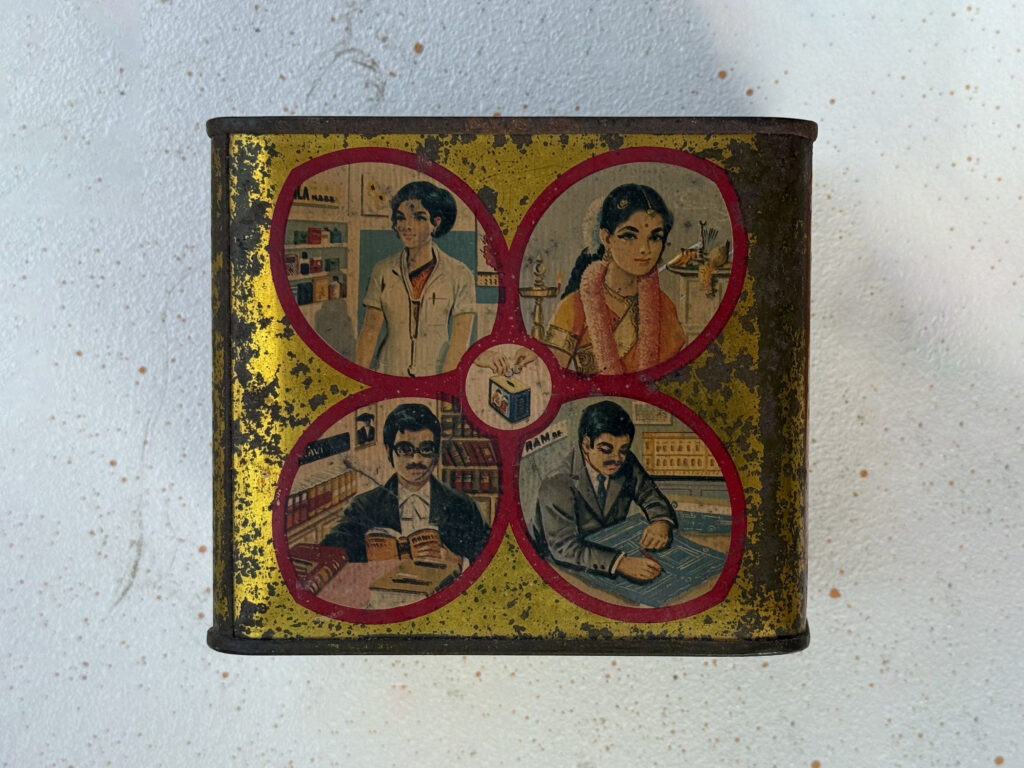
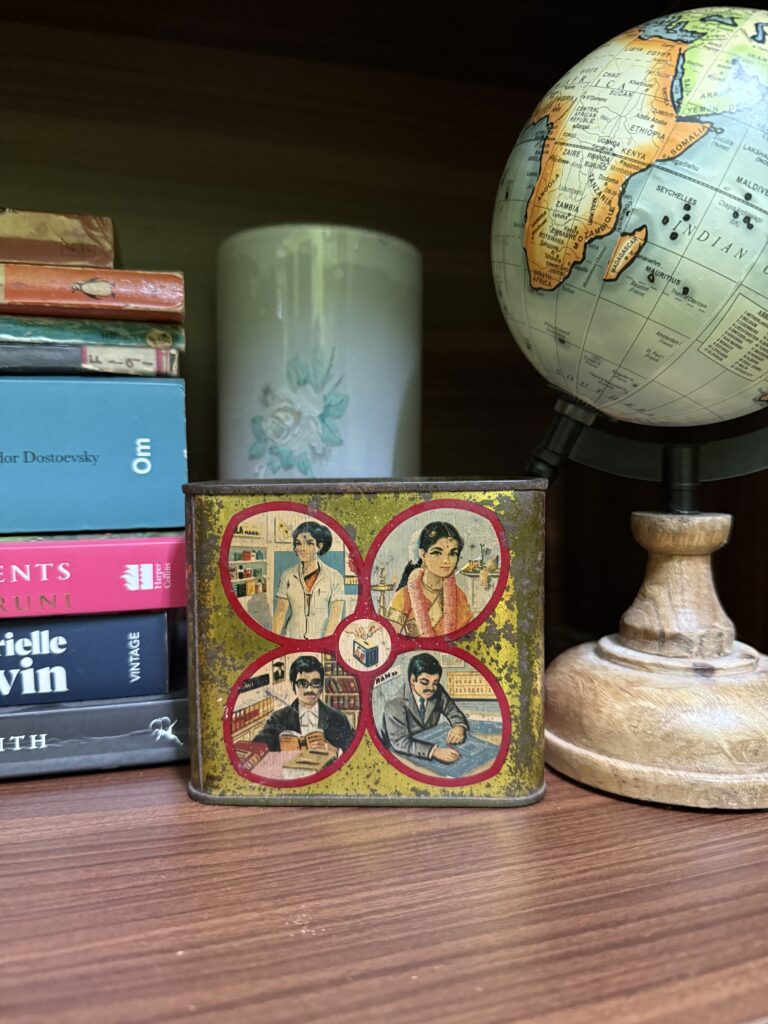
The coin bank is a cube, about the size of my palm. Its red borders have dulled, and the yellow paint has darkened with time, but its charm has not faded. On its front, it proudly reads “Madras Central Co-operative Bank Ltd.” in neat black letters, framed with a geometric pattern that once looked grand. What catches my heart most are the tiny illustrations on its side: four little circles showing the life one might hope for, a nurse caring for her patient, a woman cooking in her kitchen, a man reading a newspaper, and another writing at his desk.
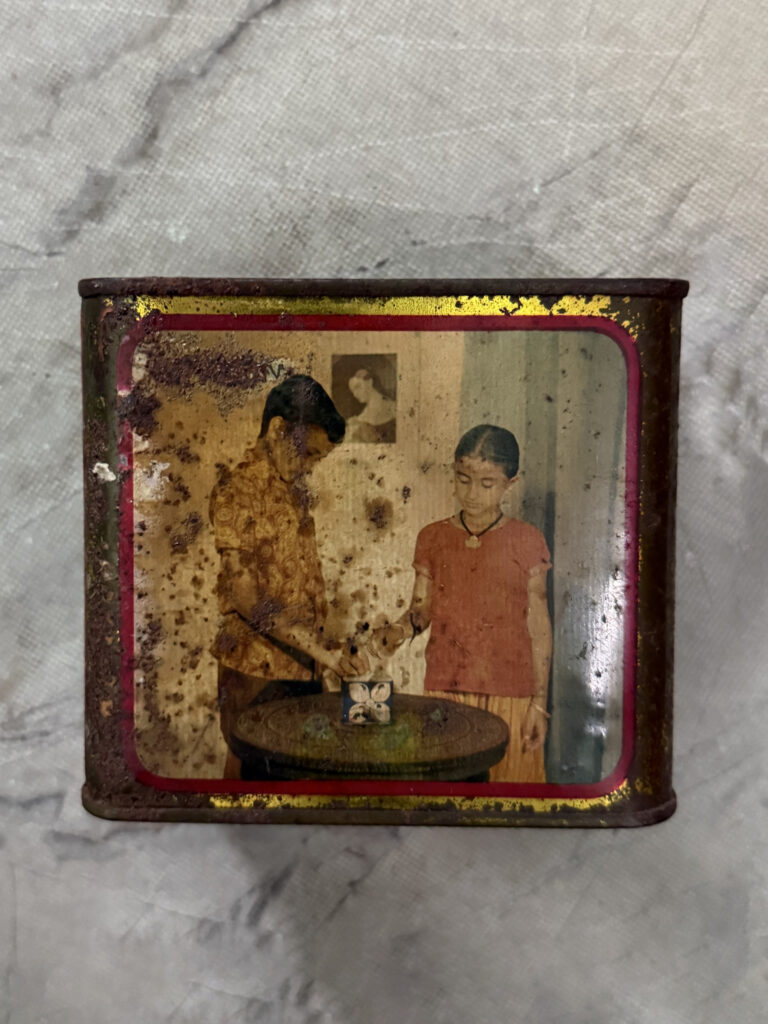
Right in the middle of these four scenes is a small illustration of two children dropping coins into a tin, just like this one. I often think of that image as the heart of the box. It is as if the coin bank knows what it stands for: saving, nurturing, and hoping. The pictures around it show what those small savings could eventually become: education, work, family, and stability. For my grandfather, who built his life with discipline and quiet determination, this little tin must have been more than an object. It was a promise that even the smallest acts done with care could build something lasting.
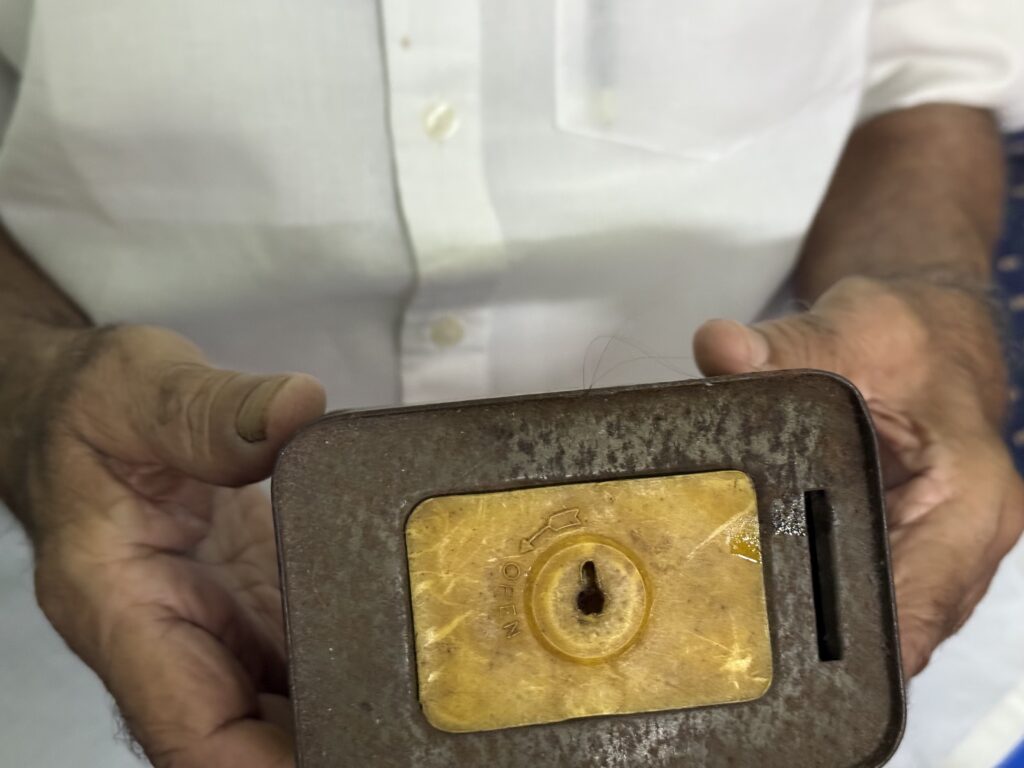
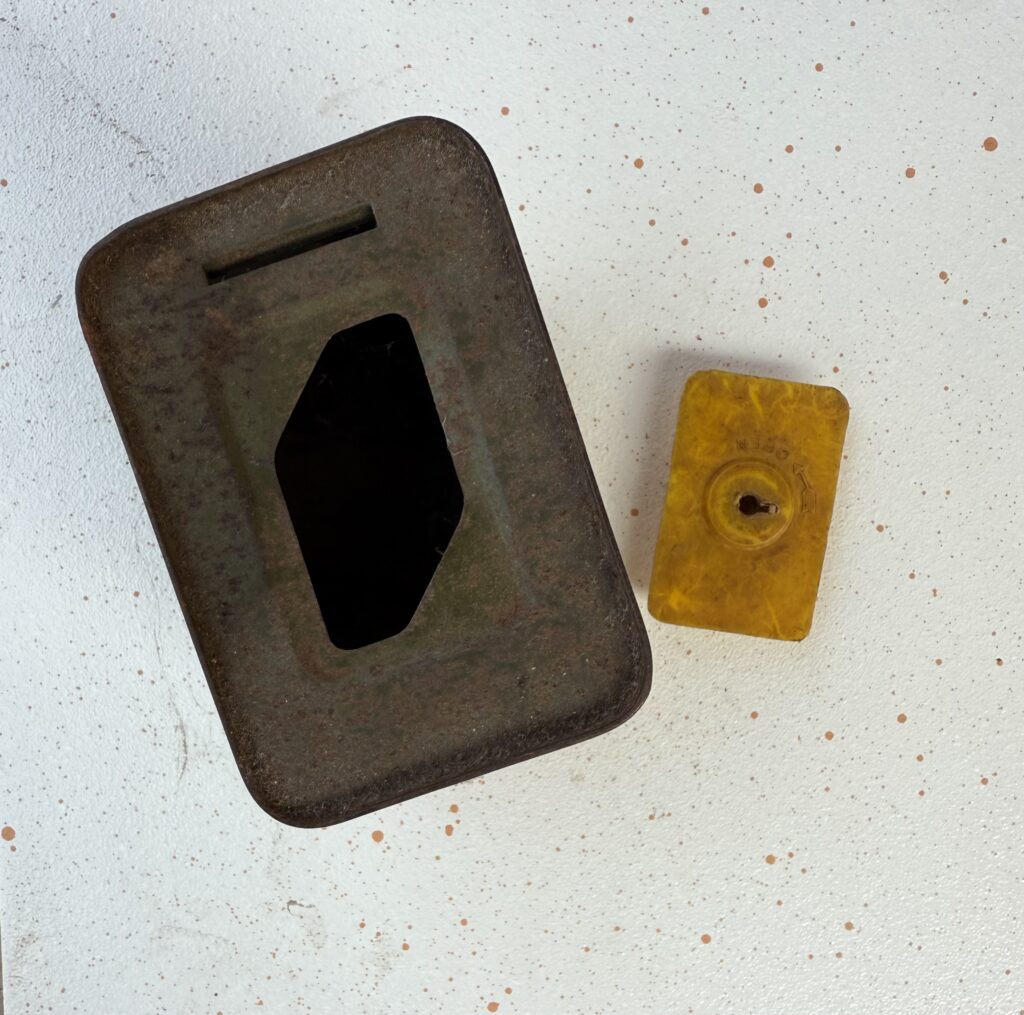
Over time, the coin slot bent from repeated use, and the plastic key broke, yet my grandfather never threw it away. When shiny plastic piggy banks became common in the 1980s and 1990s, light and colorful, this metal one stayed behind, heavy, dented, and steadfast. It traveled with him each time he moved, from the railway quarters near Royapuram to the family home in Tambaram. My mother grew up with this tin in the house — she likely first noticed it when she was around 15 years old. It always found its place on a shelf beside a photograph or a clock, quietly watching the days go by.
I first noticed it very closely only a year ago, when I stayed with my grandparents for a longer time. Sometimes, when I visit, I still see it there, the same shelf, the same faint glint of red under the afternoon light. My grandfather sits nearby, often reading the newspaper, a cup of tea beside him. Even though coins no longer fall into it, the tin still seems full, full of years, of patience, and of stories untold.
To me, this little coin bank is a piece of Madras itself – a city learning to save, to plan, and to hope. The culture of metal tins began in Britain during the Industrial Revolution in the late 1800s. As tinplate manufacturing advanced, Britain perfected a method of coating thin steel sheets with tin, making them lightweight, rust-resistant, and inexpensive. This led to the mass production of printed metal containers used initially for packaging biscuits, tea, and tobacco. Companies such as Huntley & Palmers pioneered decorative tin designs by using lithography on tinplate, making tins colourful, collectible, and visually desirable. Their beauty and durability allowed tins to enter domestic life, where families reused them to store – most popularly – sewing items, and in many homes the butter cookies tin became the quiet keeper of needles and threads alongside valuables or coins.
In Victorian Britain, banks adopted tins as tools to teach thrift and self-discipline, distributing “saving banks” that could only be opened at the bank. Through colonial transfer, this practice reached India, and co-operative banks in Madras began using tin savings boxes from the 1930s onwards. Even today, these tins linger in homes, showing how colonial habits quietly shaped domestic routines. British metal tins more broadly emerged during industrialization when mass production of tin became possible. The imagery on many of these tins was imperial in theme, displaying the British flag or symbols of Empire, embodying power and authority. Unlike American cast-iron banks, which were mainly entertainment objects, British tins conveyed political and cultural messages, even when used for mundane purposes like storing coins or food.
The Madras Central Co-operative Bank, born in the 1930s, aimed to help ordinary people manage their savings. Through this tin, that goal reached our home and stayed. It carries the memory of an older Madras, of a man who worked hard and dreamed quietly, and a family that still treasures his habits and values.
Today, when I look at it, with its rust, its dents, and its faded paint, I do not see wear. I see warmth. I see my grandfather’s hands. I see the story of a city and a family tied together through something so small, yet so enduring. This tin coin bank, to me, is a museum in itself, holding inside it the memory of coins, the pulse of Madras, and the grace of my grandfather, who still believes that even the smallest savings can build a life.