
TEXT AND PHOTOGRAPHS BY KRITIKA KARKI
VANITY BOX BELONGS TO VANDANA TARAGI
Dehradun, Uttarakhand
“Let me show you something that belonged to my grandmother”
With these words, I was made privy to the most elegant vanity box I have ever come across – an object of pure grace and luxury, made by hand a 100 years ago. My aunt had quietly preserved this memory from her grandmother for decades. She knew that I had started archiving our family’s history and chose to share her heirloom with me.
What started as a personal project, the Karkis of Kumaon family archive, soon grew beyond the immediate family tree. Each object and story was a clue leading to another, like a forest trail. In the tightly knit Kumaon of the early 1900s, lives overlapped naturally and the archive began to reflect that shared, interwoven history.
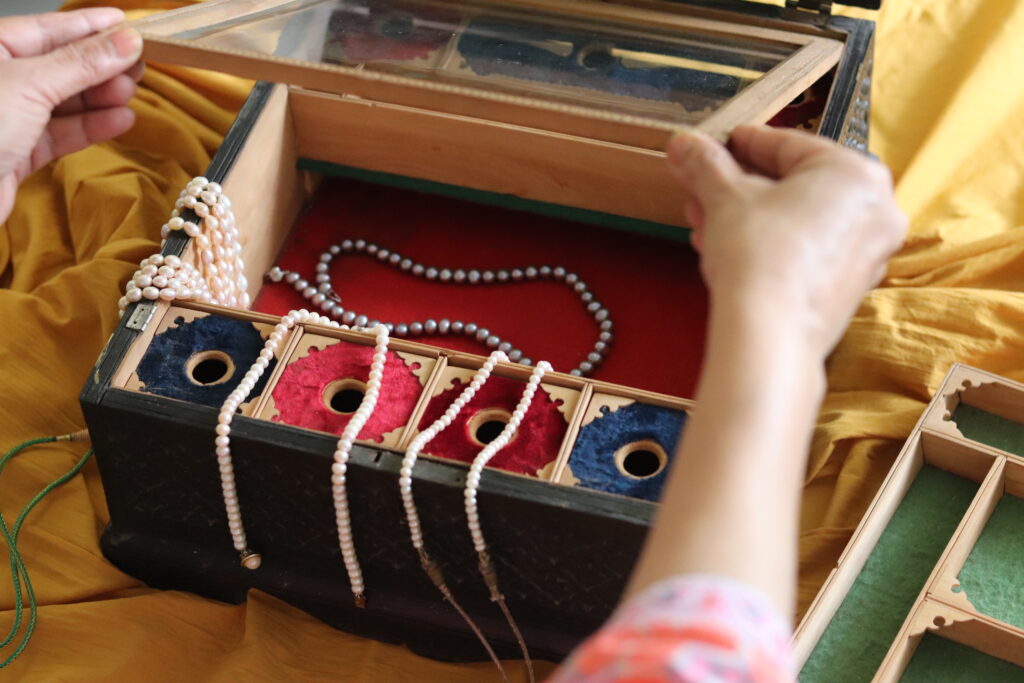

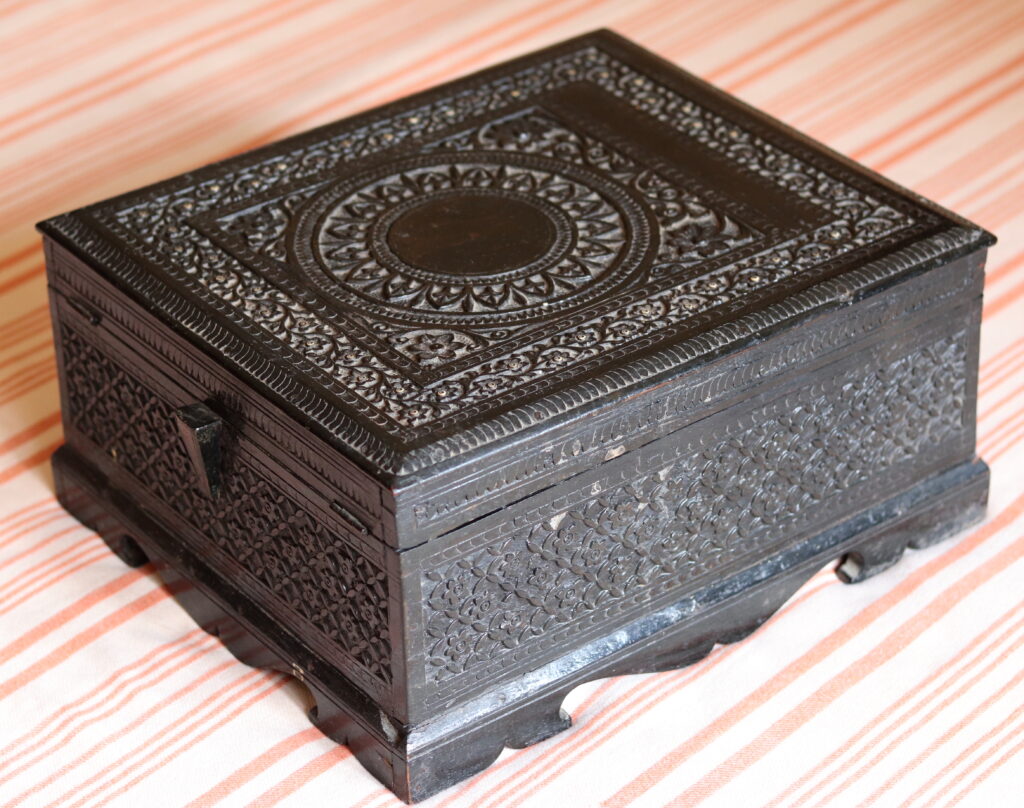
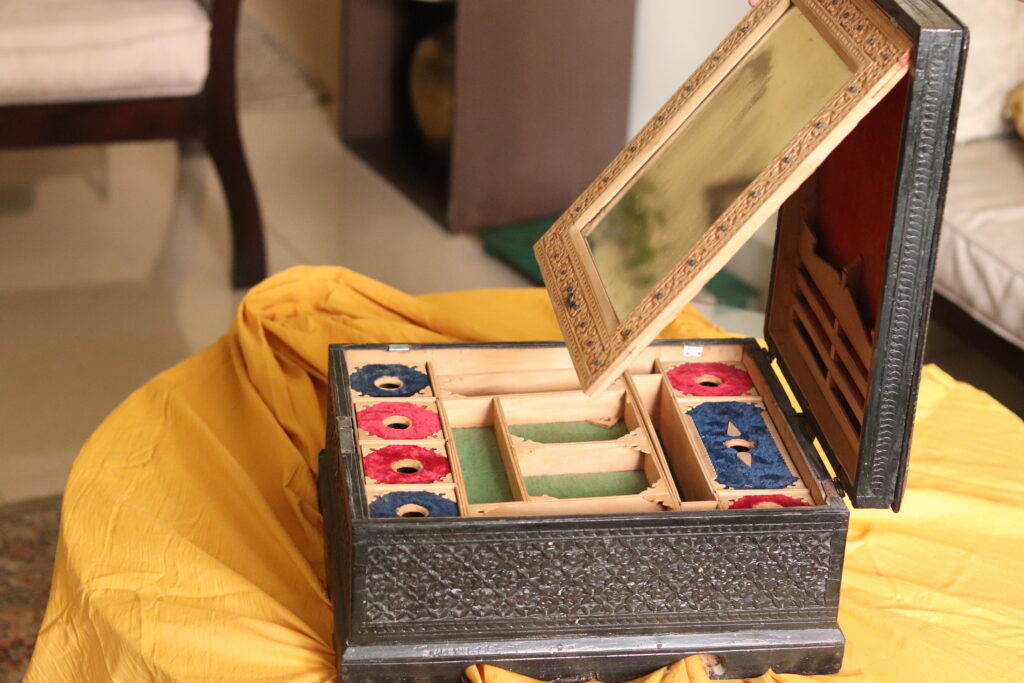
The dark wood box, sitting in my aunt, Vandanas’s drawing room became another object to add to the archive’s wide tapestry. Sitting sizeably, at 14 inches in length and 12 inches in breadth, it could easily be mistaken for an ornately carved low side table. However, come closer and the magic inside is revealed. The vanity cum jewellery box from the early 1900s, sits pristinely preserved in the hands of its third owner. Originally, it belonged to Parvati, who passed it on to her daughter (Prema) who then gave it to her daughter and my aunt (Vandana). Never actually used, it was carefully passed down across three generations of daughters. “The box belonged to my grandmother, and we were told it was a part of her bridal trousseau”, says my aunt Vandana.
The year is 1919 and the box is for Parvati, the young bride. It looks grand and the velvet lined interiors jump out against the light sandalwood work. A hidden compartment for jewels, a nook for envelopes, maybe combs? Perfectly drawn holes for lipstick, kumkum or even perfume. My aunt opens the box and we see a large pockmarked mirror in the back of the lid, transporting us instantly into the shoes of a young lady navigating life in the Kumaon hills.
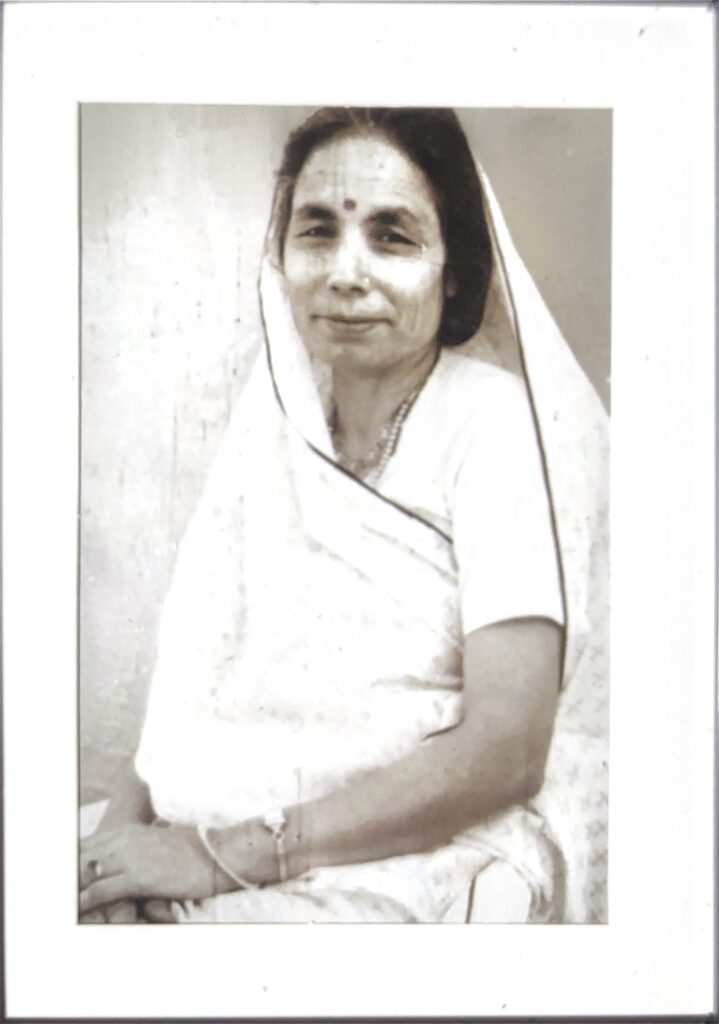
Parvati Bisht nee’ Bora was born in 1908 in Almora, Uttarakhand. A serene hill town under the jurisdiction of the British – Almora was a culturally rich and politically active town. It served as a melting pot of natives from Kumaon, Garhwal along with migrants from nearby Tibet and Nepal. Meet Parvati, a middle child in a family of 6 brothers and sisters. In 1919, 11 year old Parvati was wedded into an illustrious zamindar family of the nearby Katyur valley, home to the famous Bageshwar and Jageshwar temples. Diwan Singh Bisht, her groom-to-be, held significant influence in the region. While we do not know much about their relationship – a girl getting married to a much older man can hardly be counted as an easy transition. The young bride and a significant age gap may be difficult to digest, but we were a different country back then and those were different times. I savour the lattice work on the edges of the box and make a mental note to research on the wood work and engraving. I prod my aunt with more questions over lunch. Where did she spend her life? What kind of a person was she? And listening to her story, unsurprisingly revealed a life pre-written for many women of the hills, one of perseverance and strength in the face of adversity.
After her marriage, Parvati conceived her first child at the age of 19. The blessing of a son soon gets replaced by a tragedy. At the tender age of 2, her son passed away due to pneumonia. A lack of medical infrastructure in the hills, helplessness and the apathy from the incident left a deep impression on her heart. In a couple of years, she had another child, a baby girl this time. Around 1931, after the birth of her daughter, she made the decision to move out of her husband’s home in Katyur and go back to live with her parents in Almora. Again, we do not know the circumstances of that decision, but one can imagine the boldness it would have taken young Parvati to leave with a young daughter and live life on her own terms. Independent in spirit, she settled back into Almora and very soon became actively involved in the local political scene. A member of the RSS, she hosted many patrons of the Jan Sanghi party (precursor to the modern-day Bharatiya Janata Party (BJP).
Her generosity and forthcoming nature kept her close to her community and she was famously known as “Thap Bubu” in local Kumaoni dialect. The name refers to her round facial features and ‘bubu’ refers to aunt or bua.” My aunt clearly remembers people always teeming in and out of her grandmother’s house. Soon, Thapuli Bubu had become an important figure in the community. In the 1950s and 60s Parvati continued her work in the service of the community. She was brave and decisive. During election times, she was known to prepare enough food to feed the whole town. She never took the centre stage yet her presence was required at every major political or cultural visit that happened in town. Ambitious and passionate, she ensured her own daughter grew up and focused on academics as well.
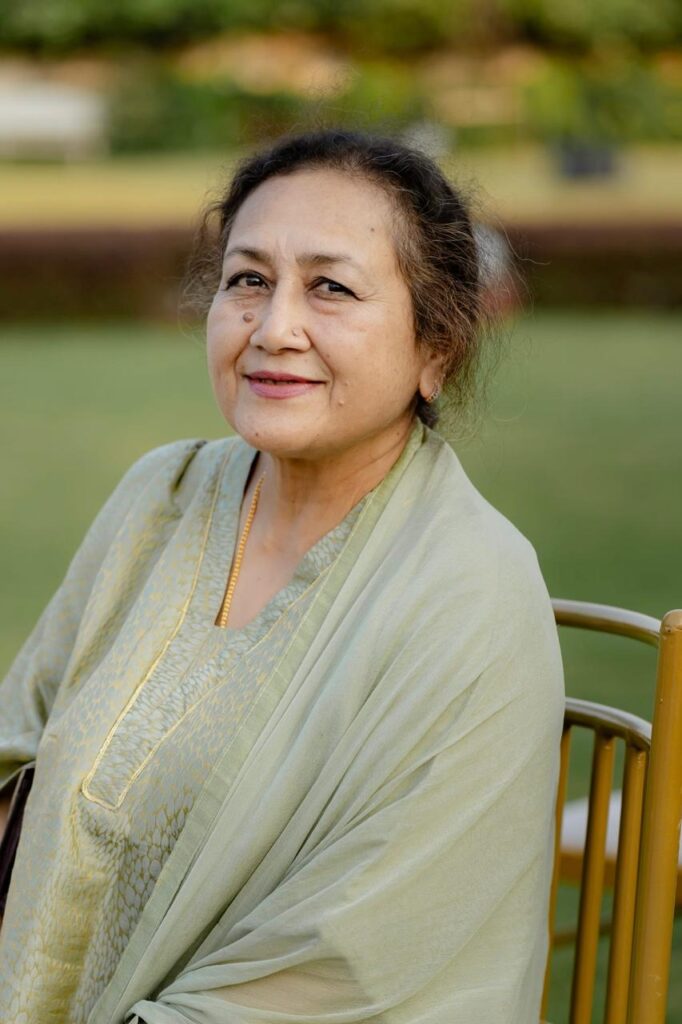
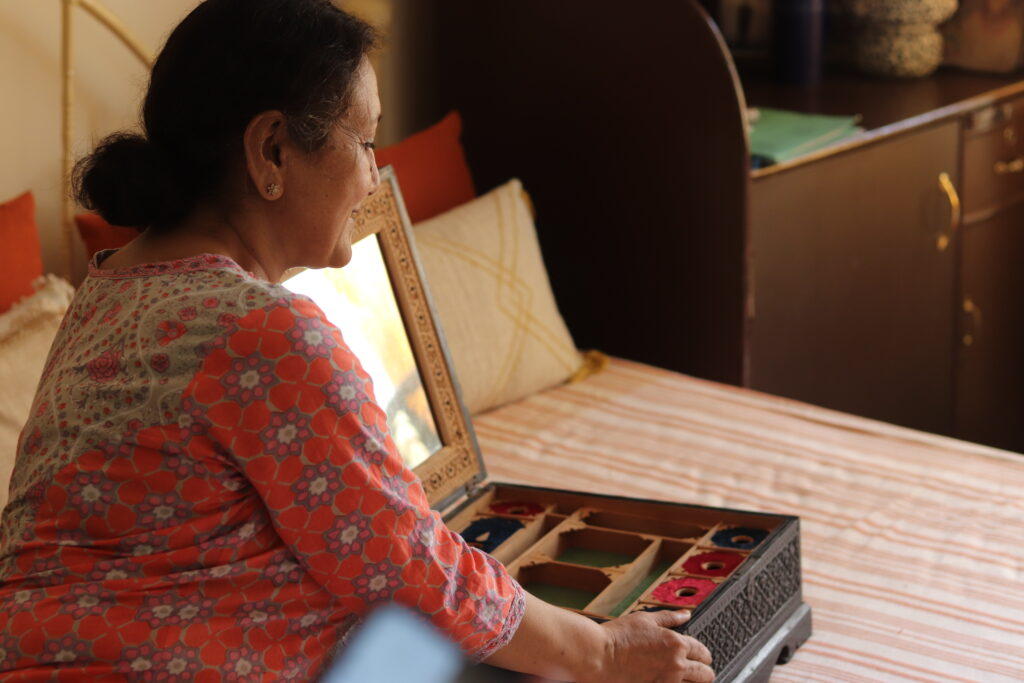
The passing of the vanity box to her daughter and then to my aunt seems almost symbolic. It made me wonder, what do women seek to pass on to their daughters when they marry? A sense of belonging? Strength to move to a new home? A sense of security? Maybe, for my aunt, the vanity box became a reminder of her resilient grandmother and her deep love for her.
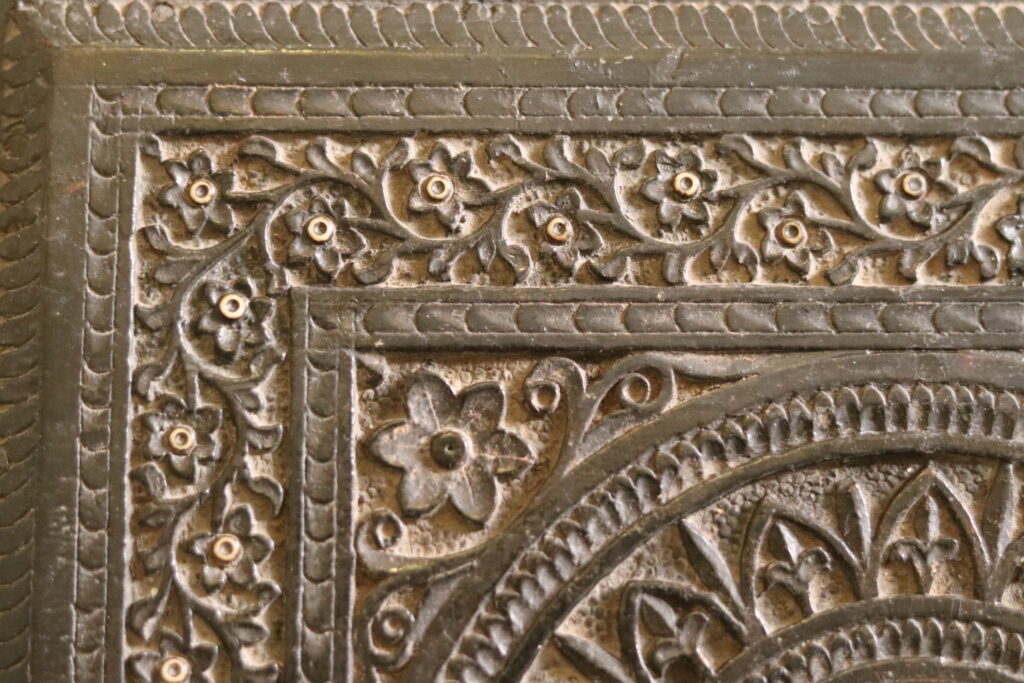
“The box fascinated me since I was a young girl, packed away in a cotton cloth in the trunk – it was a mystery for us kids”. In 1987, Parvati quietly passed away in Nainital. She continued to live with her daughter till the end, leaving behind a legacy of a life well lived and fought. However, the question still lingered in my mind – What were the origins of such intricate woodwork – and how did it reach the hills? The outer wood of the box is dark, probably ebony. It features a smooth circular disc, surrounded by a ring of stylised flowers similar to the fluer-de-lis. Concentric bands of beading and scalloped lines radiate outward, creating depth and rhythm. On a closer look, the pistils of the flower are whitish – yellow and look like ebony/bone inlay work.
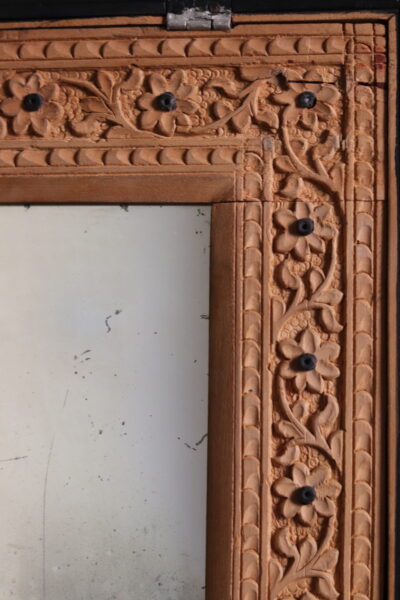
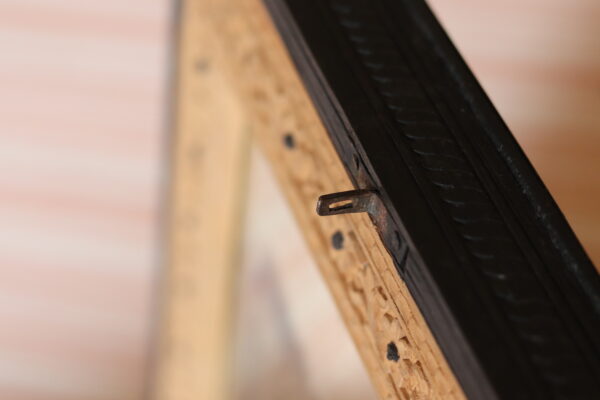
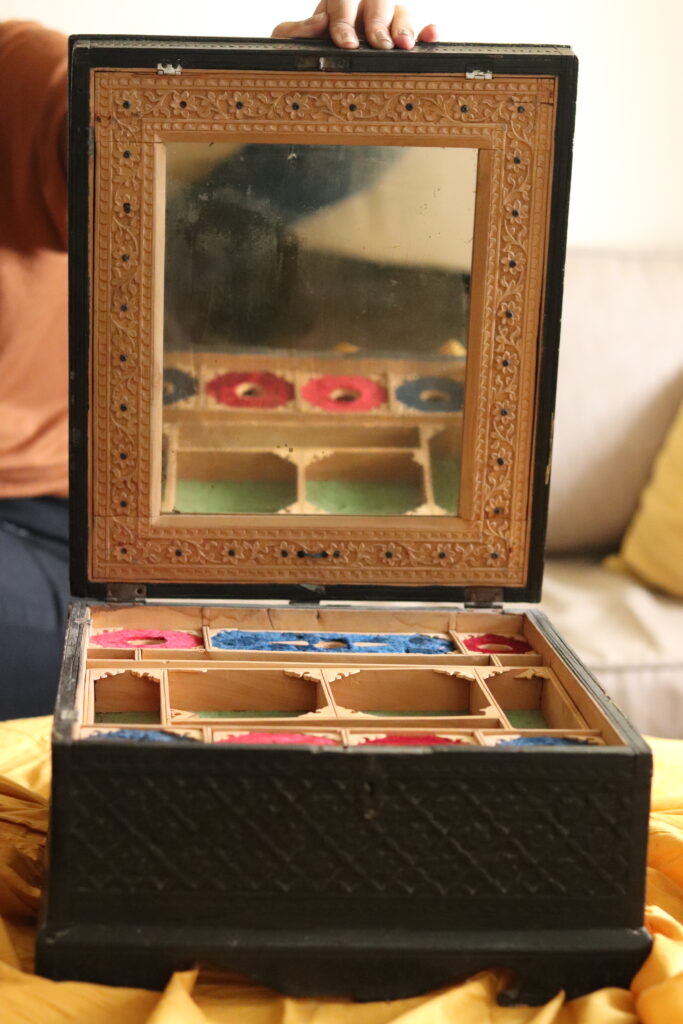
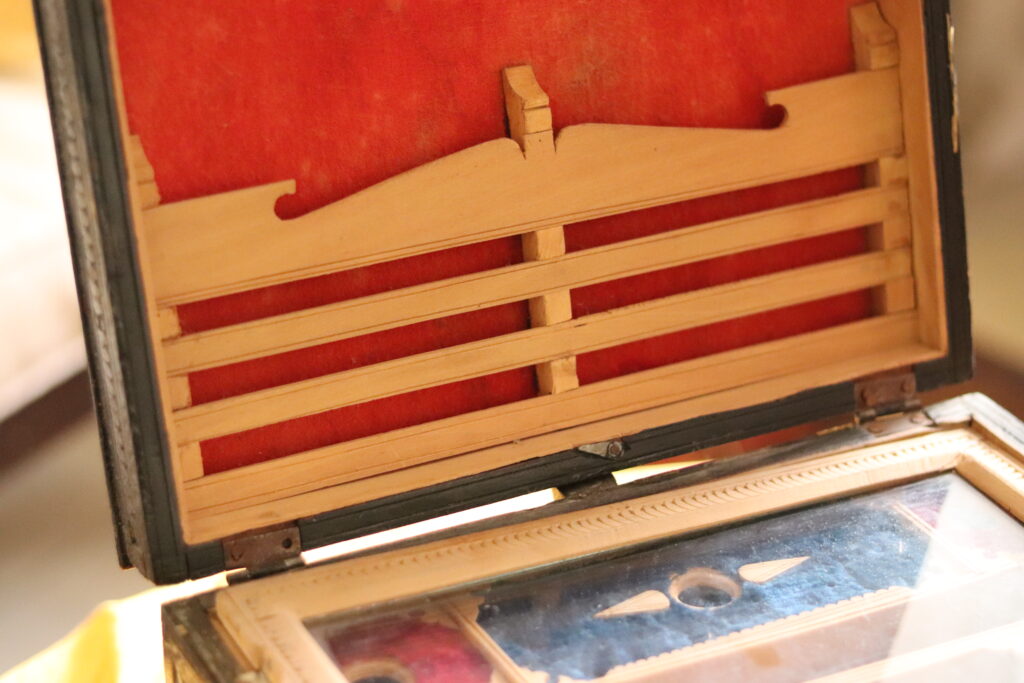
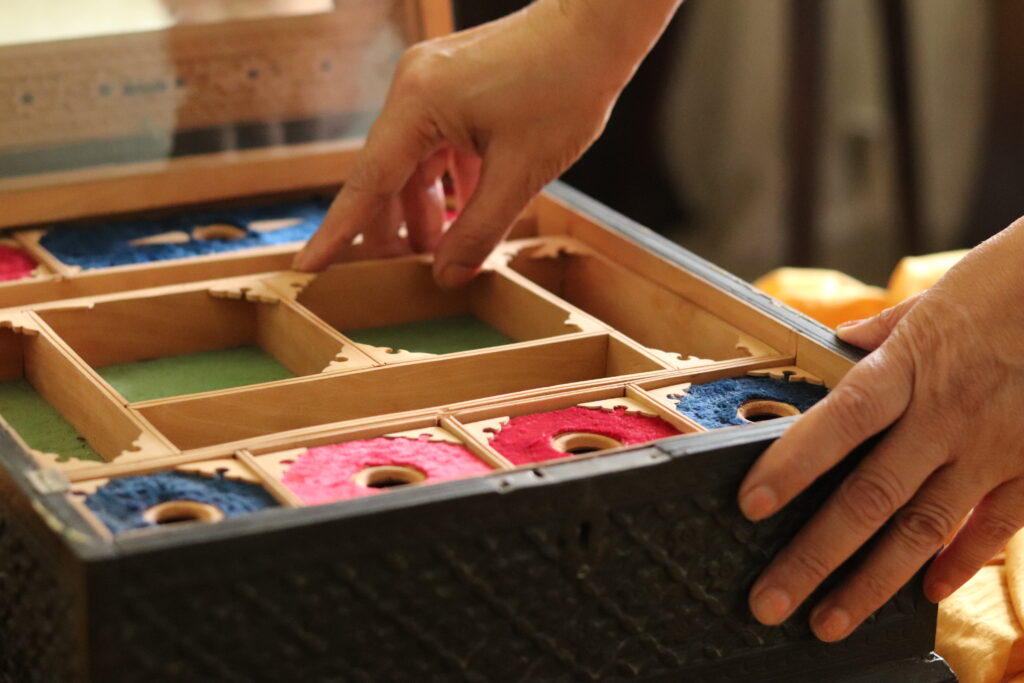
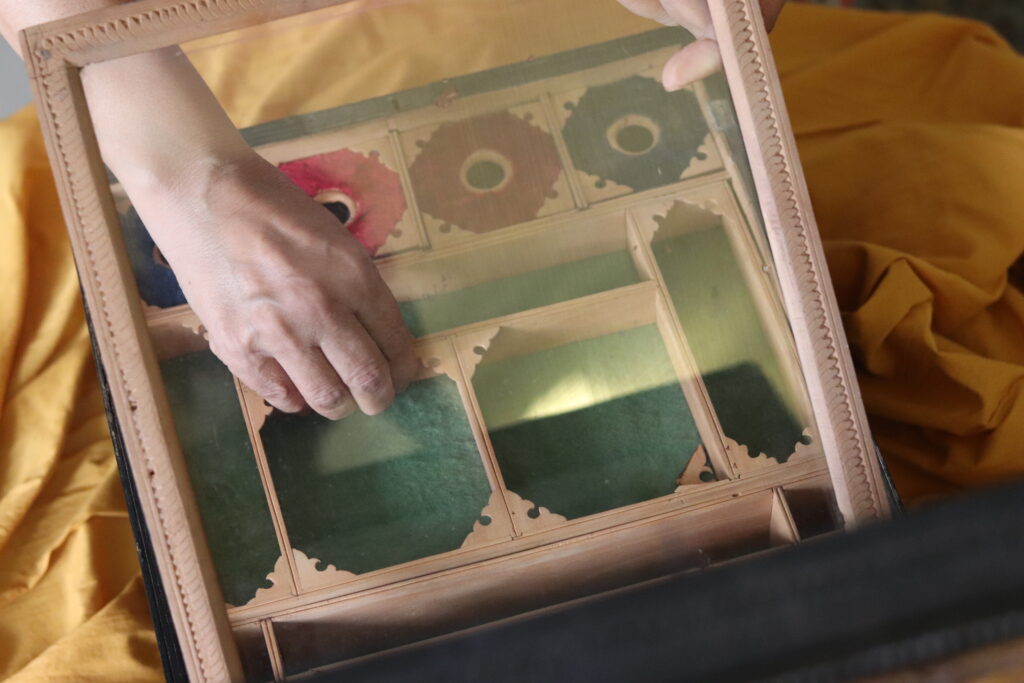
The box itself holds many layers, compartments and hidden nooks. It opens to reveal a mirror framed in delicately carved wood, bordered with small floral motifs. The mirror can be lifted, and shallow wooden slats form narrow compartments, backed with red fabric, likely meant for slim personal items. The bottom is covered with a glass covered frame, once lifted, revealing more storage below. A grid of small wooden compartments, all neatly fitted together. The sandalwood is pale and smooth, with delicate scalloped cut-outs along the edges of some dividers, softening the geometry.
These compartments are lined with velvet fabric pads in deep hues—indigo blue and a warm crimson red. Each of these pads has a circular opening at its centre, like a recessed ring or socket, possibly meant to cradle round or cylindrical objects. Beneath the compartments sits the main body of the box, lined in a rich red fabric. There is a certain thoughtfulness in its delicate design, meant for careful care and handling. The frame of the mirror is carved from pale sandalwood and decorated with a continuous floral vine that runs along the edges. Small flowers emerge at regular intervals, with black pistils connected by curving stems and leaves. These dark pegs or studs are set into the frame at intervals, likely both functional and decorative, anchoring the mirror securely while punctuating the floral pattern. We can see slight irregularities and fine cracks, softened edges, and tool marks—signs of age and handwork.

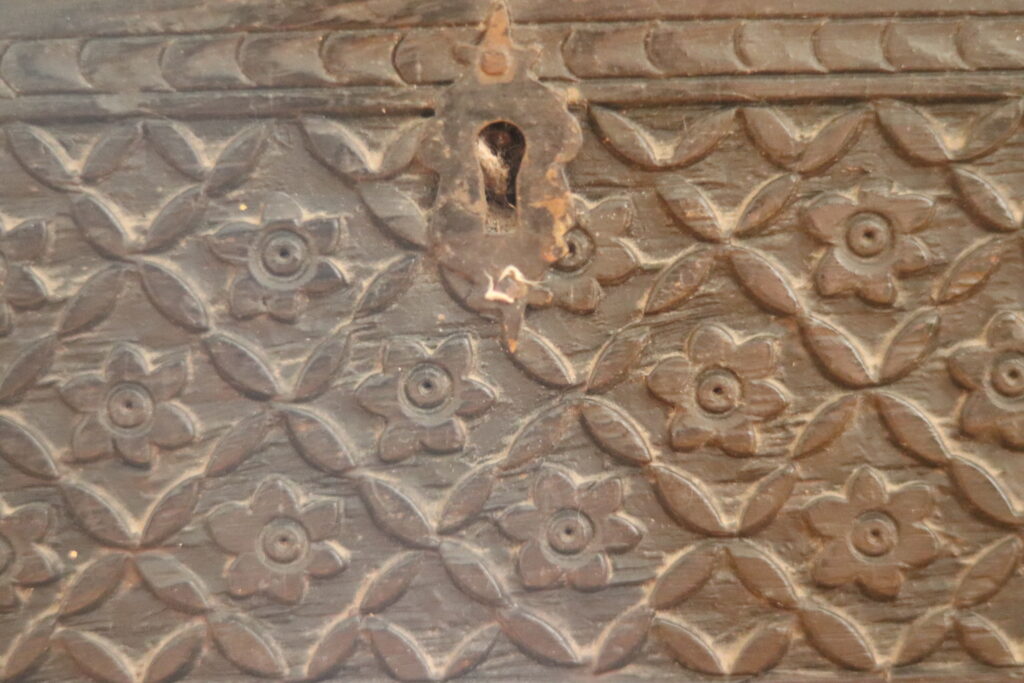
With no one left to verify the origins of the box, I tried a google image search with close up pictures of the woodwork. The immediate results throw up similar looking boxes labelled as “Anglo Indian style boxes”. Evidence suggests that possible patrons for these kinds of boxes were the British in the 19th and 20th century, for whom these boxes were customised and created. There is a mix of Indian aesthetics and western functionality, possibly a blend driven by overseas demand. Google also shares that these kinds of boxes with detailed carving and dark wood boxes compartments were manufactured in either Uttar Pradesh or Visakhapatnam in Andhra Pradesh. The logical conclusion is to point towards Nagini or Saharanpur in UP, which would fall under the same province Almora. However, further investigation using more AI reveals that sandalwood interiors with velvet lining could also be a sign of Anglo-indian work from Vishakhapatnam.
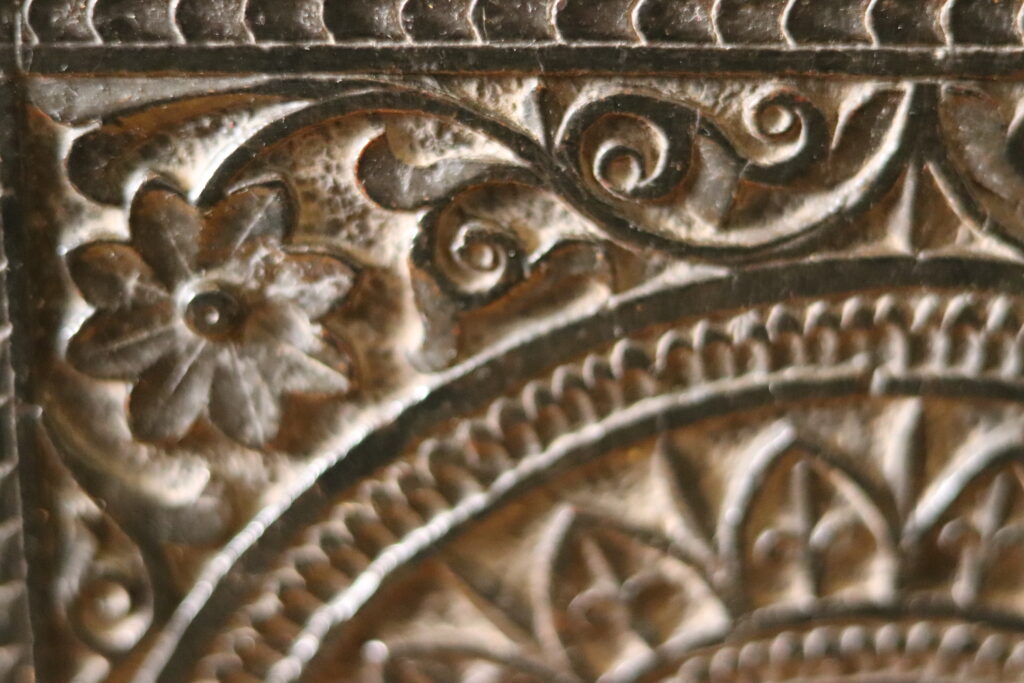
I combed the internet and found two boxes, which were very similar visually to our box. Both of these were featured in international antique selling websites. The first one shows a darkwood box with the description “filigree ornate and sculpted floral decoration on all sides with a sandalwood interior”. It is listed from Visakhapatnam and dates to the 20th century. The other one is much more similar in size but empty inside and no provenance is mentioned, other than the fact that it is a trinket box from the 19th century.
If there is a possibility that the box was indeed handmade in Visakhapatnam, how did it find its way to the upper reaches of the Himalayas? What routes, relationships, and networks carried such an object of luxury across to the remote landscape? It is clear the box was made for a woman of dignified means and its careful preservation, renders it priceless. At present, the box is approximately 113 years old and has begun to show subtle signs of ageing. The key to the lock is missing, the velvet lining is wearing away, and a few edges of the compartments are broken. Like an ageing beauty, the vanity box now asks to be handled with greater care; it has travelled far and wide.The journey has been long – what started with young Parvati in Almora, a stop in Nainital, travelling across India with Vandana finally ended in Dehradun. A granddaughter’s safe hands have kept her story alive and we can’t wait to hear what chapter the box will hold next.
The search continues: The Karkis of Kumaon archives seeks to document and share stories, oral histories and objects from the community and the region. If you possess or have any information about such wood work and it’s possible origins kindly email us at [email protected]
Beautifully weaved. Your narration helps us to visualise the whole story.
Writeup by Kritika displays amazing writing skills.Wish her a grand success in this field.Looking forward to reading a book by her.
Very well weaved. The narration looks like an old movie. Great job.
Kritika has brought the box back to life with her well crafted narration. The life and strong personality of Thap Bubu has been beautifully woven Into the journey of the box ,that now adorns her grand daughters drawing room. The craftsmen who gave it life and the admiring eyes that chose the box as a wedding gift to a young bride ,a hundred years ago ,are long gone . But their gift continues to tug at our curious souls . And shall continue to draw coming generations as well.
Very well written.
Beautifully written