The Bidai Saree

My aunt, Neelam, tells me that this silk banarasi saree had been a gift to my grandmother, Chandrika Devi, from my grandfather’s side and she wore it at her bidai, when she left her father’s home for her husband’s. It is a Gulabi pink colour and has been woven in the finest banarasi weaving technique – Kadhua or Kadwa, which means kadha hua or embroidered

The book from Oxford

In January 2019, while rummaging through my mother’s collection, I found an old looking book belonging to Daddy. With “Hem C Mahindra. Oxford. 1928” handwritten in ink on the partly stained page inside.

Touch of the maiden home

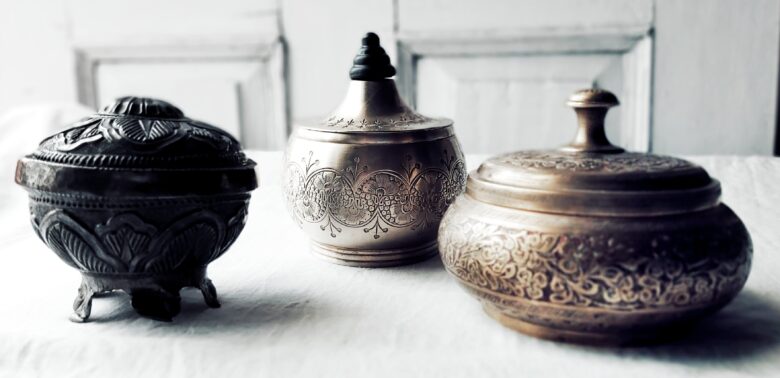
My great grandmother was born in a small village called Boala (now in Bangladesh). She possessed many aged utensils and other heirlooms, which were distributed among her four daughters as a part of their trousseaus during their weddings and some after her death.

Kalabati’s Treasure

Dating back to 1939, this coin box was a part of my grandmother’s wedding trousseau and of the two or three boxes she was given, this one survived the stretch of time and the tides of displacement. In case of a fall or dent, my grandmother would lose no time in taking it to the neighbourhood metalsmith for a quick fix. Sometimes she would ask me to accompany her, an excursion that I would enjoy every morsel of.

My grandparents’ ‘Rubaiyat of Omar Khayyam’

Omar Khayyam composed this collection of four-line stanza poems, or rubai, as they are known in Farsi, sometime between the late eleventh century to early twelfth century, before he died in 1131. History further made itself known in a personal and intimate way as I read the Bengali inscription on the first page – “To Priti and Dilip Bandopadhyay – on their wedding, 6.6.66”.

Close
© Copyright 2024. All rights reserved.
Close

Subscribe to the Museum

Receive a new story from somewhere in the Indian subcontinent in your inbox every week!

Loading