
TEXT AND PHOTOGRAPHS BY KAVERI ABROL
New Delhi, India
While digitising my grandfather, Manmohan Bawa’s collection of old photographs, I came across this photograph of the Somnath Temple dating back to the 1950s prior to its reconstruction. Nana was then an aspiring landscape painter.
The photograph captures him in front of the temple with a brush in hand, deeply focused on the act of painting. It immediately caught my attention and stayed with me, not merely as a portrait of a young artist, but as someone attempting to freeze a moment in history, translating it into lines and colour. Even in this early stage of his artistic journey, his works carried a quiet intensity- an ability to register architecture not just as form, but also the landscape and quietude of it. What the photographed image shows is not a posed figure, but an observational moment into Bawa’s artistic practice. The photograph becomes more than an image- it brings together the place, the artist, and the materials of his practice, capturing a moment in time.
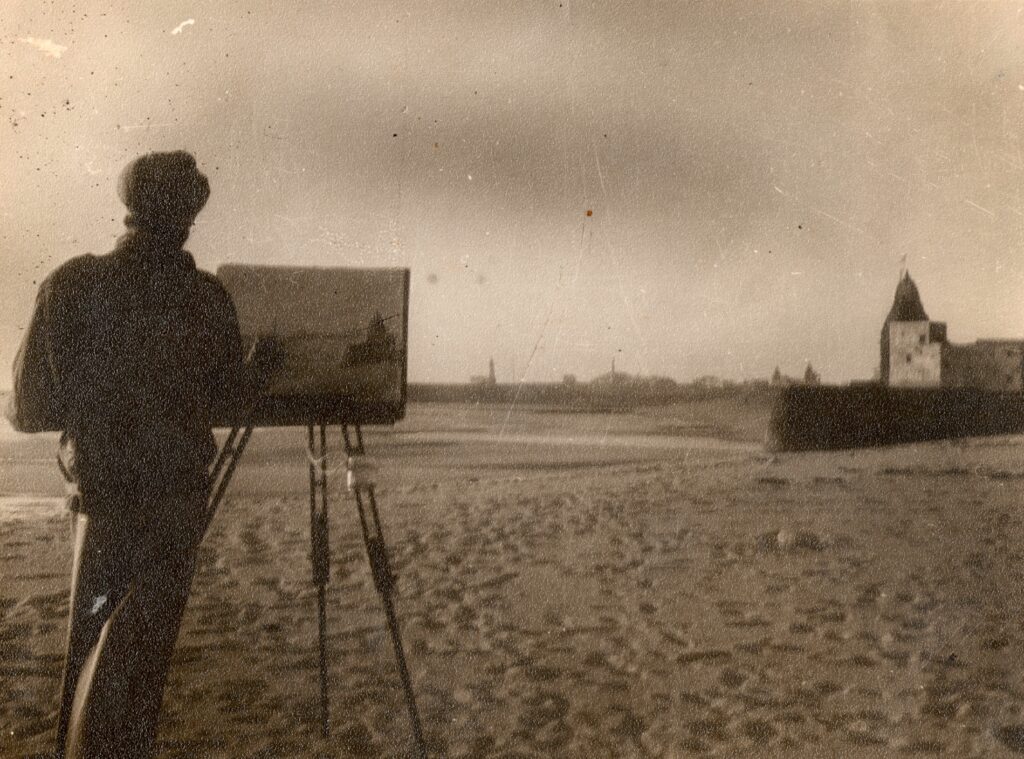
Manmohan Singh Bawa (b. 1932) is an Indian writer, painter, cartographer, and traveller whose oeuvre spans multiple creative and documentation practices. Born in East Punjab, he developed an early interest in art, history, and travel, which later shaped his diverse professional and creative trajectory. He began his professional life working in various office and press-related roles, including graphic and design work, before gradually moving away from salaried employment with the United States Embassy to pursue independent creative endeavours.
His work encompasses many forms and media. He painted landscapes particularly in watercolour, inspired from his extensive travel across India and overseas. There exists a parallel practice in cartography, through which he has produced detailed trekking maps of the Himalayan regions. He is also a prolific contributor to Punjabi literature, having authored numerous novels, short-story collections, travelogues, and works on mithihas, an amalgam of fictionalised history and myth-making. His writing includes works such as Yug Aant, Kaal Katha and Bhikshu Aur Surbhi.
Across these different practices, his close relationship with landscape remains a constant. He observes places closely and translates his experience of them into paintings, maps and words. This is especially evident in his watercolours, which he often paints on site. Watercolour can be unpredictable and difficult to control, but Bawa embraces this quality, allowing the movement and flow of the paint to become part of how he captures a place in the moment.
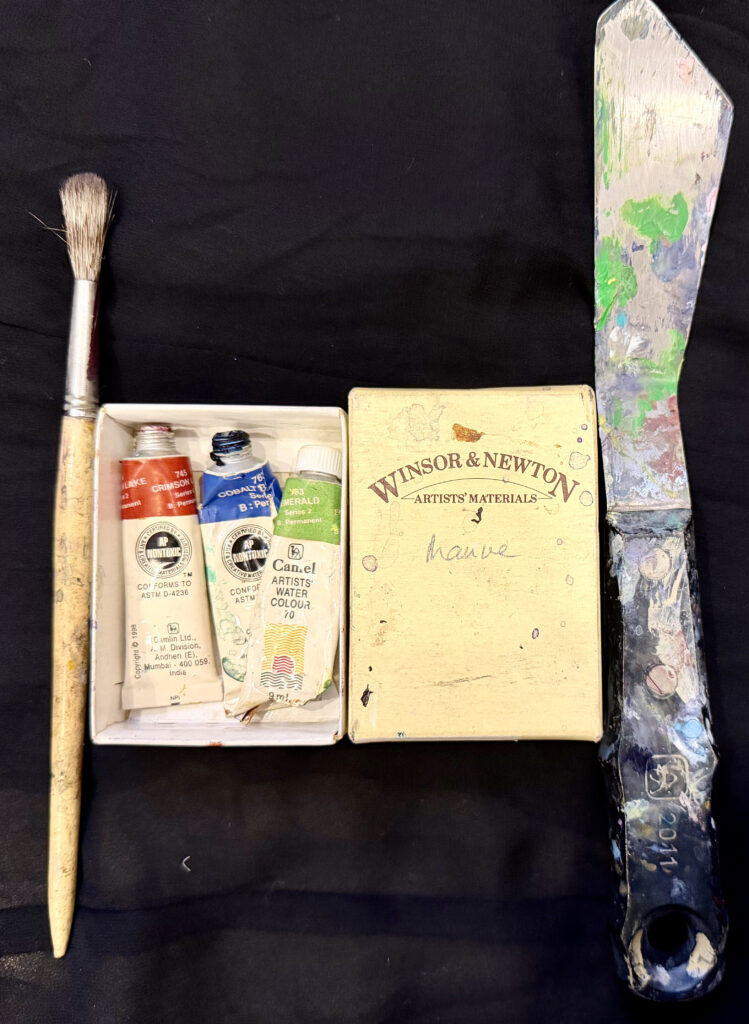
The watercolours he used were largely tubes from Winsor & Newton, acquired during his travels to England in the early years of practice, a time when access to professional-grade pigments in India was limited. These materials became foundational to his palette. Among the colours he repeatedly returned to were crimsons, cobalt blues, prussian blues and greens from the emerald range. These tones were closely tied to Himalayan terrains and open skies, where colour functions less as surface description and more as a method of registering atmosphere, distance, and light. Over time, as art materials became more widely available in India, domestically produced paints such as Camel entered his practice as well. Rather than replacing his earlier materials, they existed alongside them, quietly tracing a shift in the material conditions of artistic work in post-Independence India. In the photograph with the temple, these materials are not visibly apparent, yet they are fully implied- present as the invisible substructure through which the landscape is translated into an image.
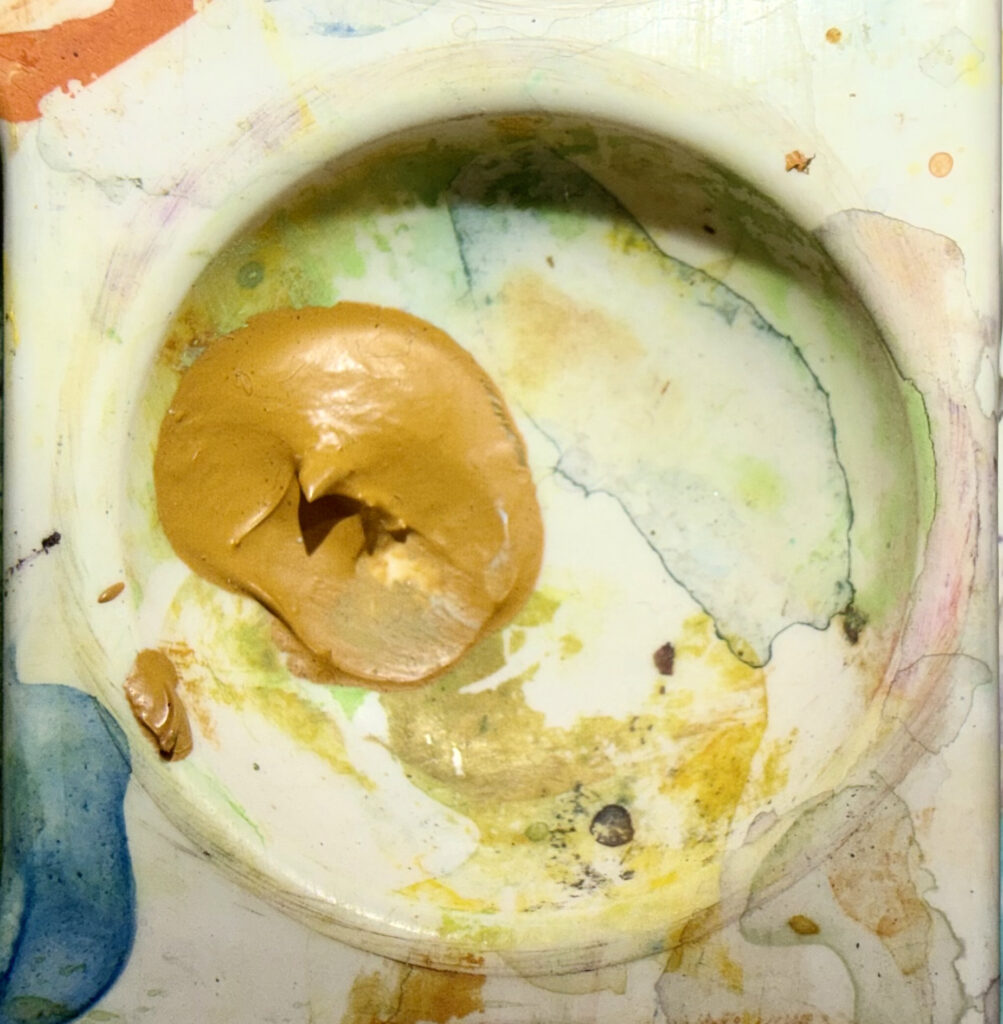
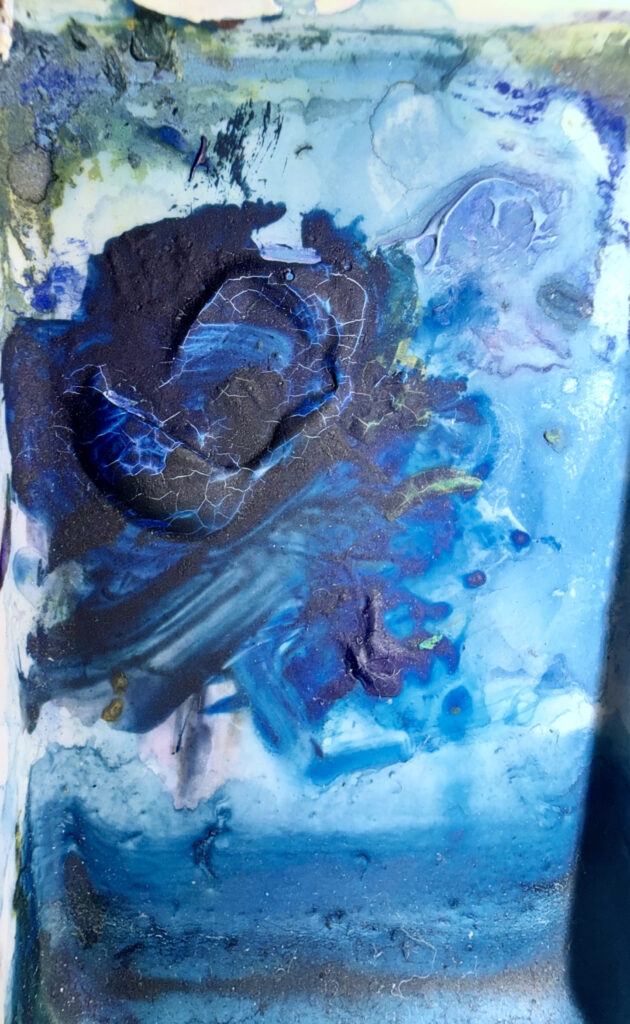
The paints palette he used is a long rectangular board marked by two parallel systems of use: circular wells for pigment and elongated, slanted grooves for mixing. Over time, these divisions have been almost entirely dissolved through repetition. Acquired during his travels in the United States, the palette carries layered pigments in blues, greens, ochres, greys and browns. They are no longer separated into sections, but merged into a continuous field of residue. Water has softened the surface and pigment has hardened in places into dense deposits, as if accumulated time has been compressed into matter. It no longer functions merely as a structured instrument of preparation, but as a tangible record of repeated decision-making. In moments of painting, it represents the surface where colour comes into existence or be-ing before it ever reaches the brush. I remember seeing this palette in use when I was younger watching him move between tones with quiet precision. I would stand nearby as he mixed colours. At times, he would let me step in and make small, unfocused marks on the same surface. Those traces are not visible as separate marks today. Instead, they are absorbed into his final works.
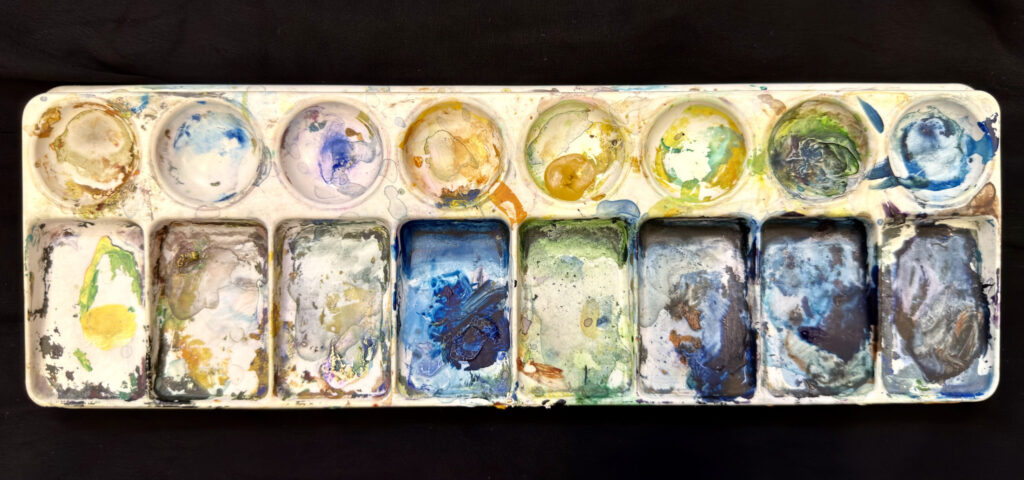
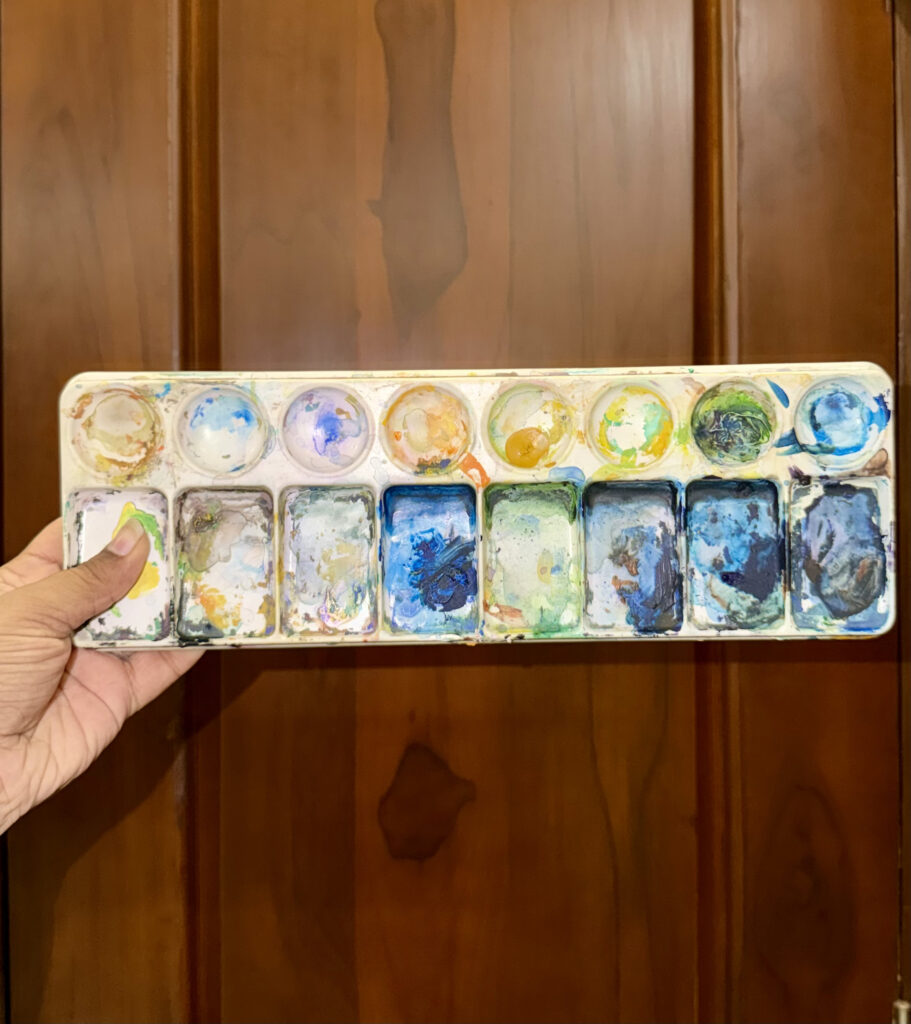
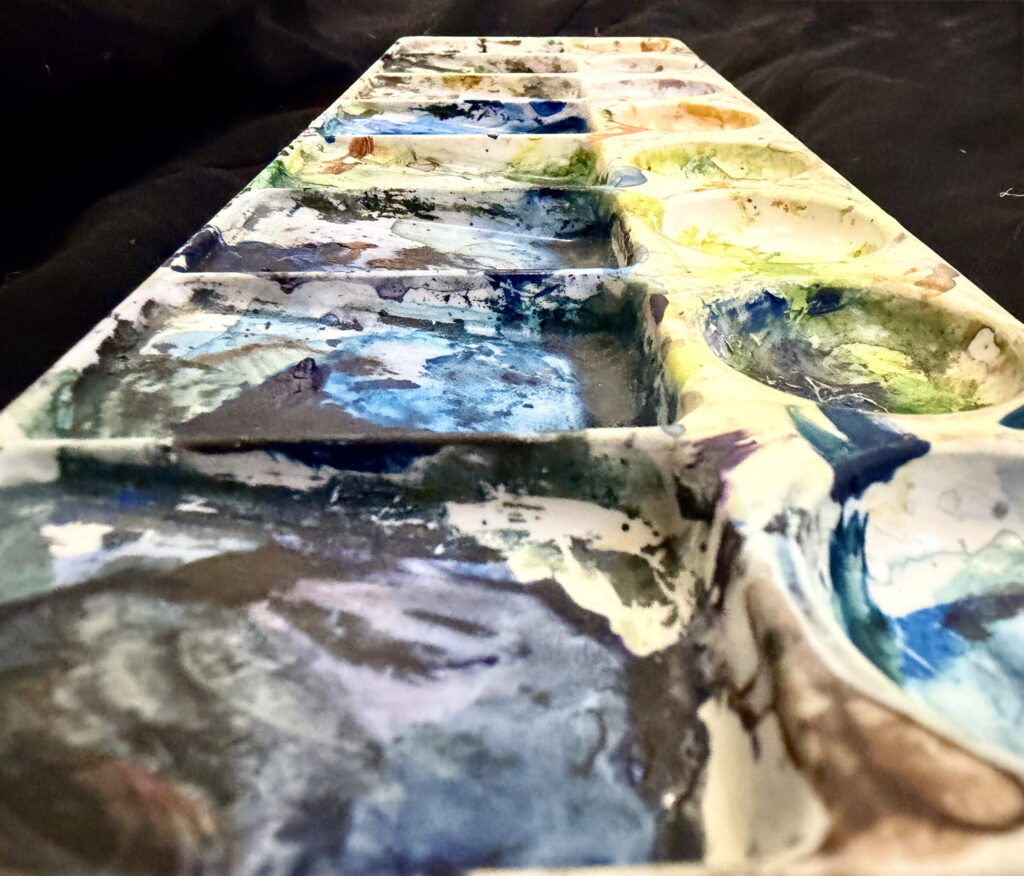
The palette itself is an artefact; with its encrusted colours, it stands as a witness to his creations. His paint knife is a tool of adjustment rather than depiction. It shifts pigment, modifies density, and alters colour before it reaches the surface of the paper. Its blade and handle are both marked by extensive use; pigment has settled into its very structure, extending beyond the metal into the grip, where layers of blue, brown, and earthy tones have accumulated. The distinction between tool and residue has gradually disappeared. Within the painting process, it occupies a quiet but decisive role: the point at which colour is neither fully formed nor fully applied, but still entirely open to alteration. Even this instrument of precision carries the heavy imprint of repetition rather than deliberate design.
I remember watching him paint when I was younger, seeing him move between colours, wash his brushes, and leave them resting in a mug of water beside his palette. At the time, these appeared to be simple rituals; today, I recognise them as part of his artistic process. Over years of use, the brushes have transformed alongside his practice: their bristles hardened by pigment, their handles stained by water and colour, carrying within them the memory of countless gestures. They are not merely tools of creation, but witnesses to the evolution of his journey. They hold the physical traces of the artist’s hand and the passage of time between the young painter captured at Somnath and the artist he eventually became.
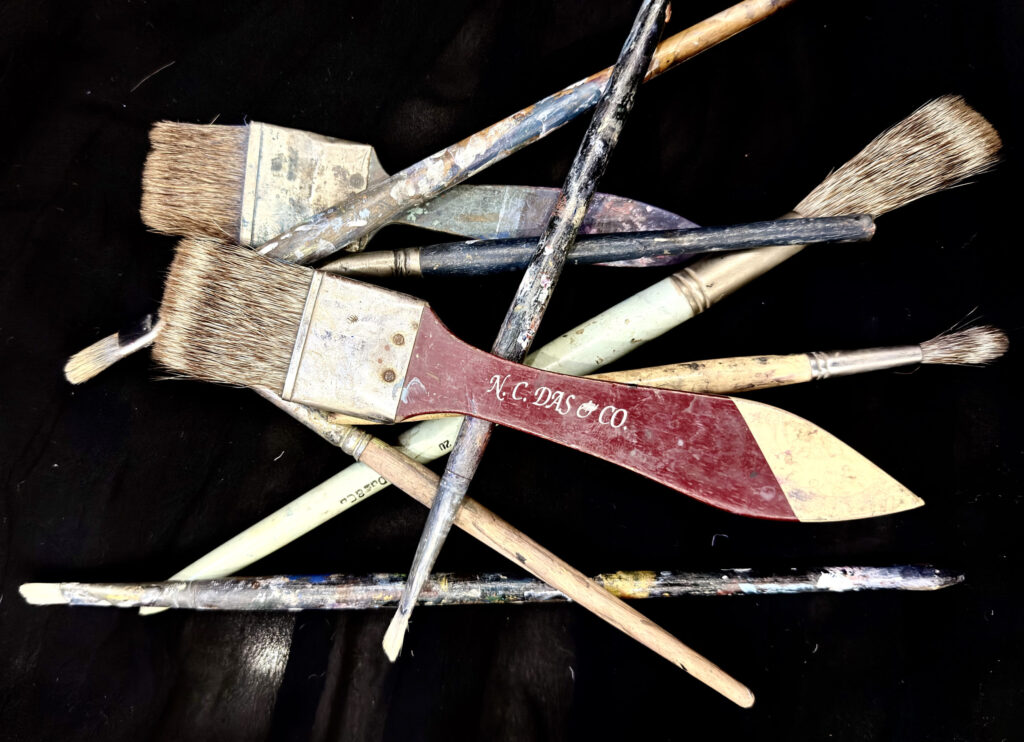
The brushes feel closest to him. Unlike the palette, which preserves accumulated decisions, or the painting knife, which records adjustments, the brushes preserve traces of his physical presence. The movement of his hand, the pressure within each stroke, and the choices made in balancing water, pigment and surface. His brushes form a varied and irregular set, sourced from different makers over time. One of them being from N C Das & Co. Some are finely tapered for detail work, while others are broader for washes and tonal expansion. Their differences in length, density, and structure correspond directly to the different modes of mark-making within watercolour practice. With prolonged use, their original softness has disappeared. The bristles have hardened through repeated contact with pigment, holding colour within themselves rather than releasing it cleanly. The handles are stained from continuous contact with water and paint, ensuring that the separation between tool and material is no longer clear. Unlike the palette or knife, which mediate colour, the brush is the point at which intention becomes visible form. It carries gestures directly onto the surface.
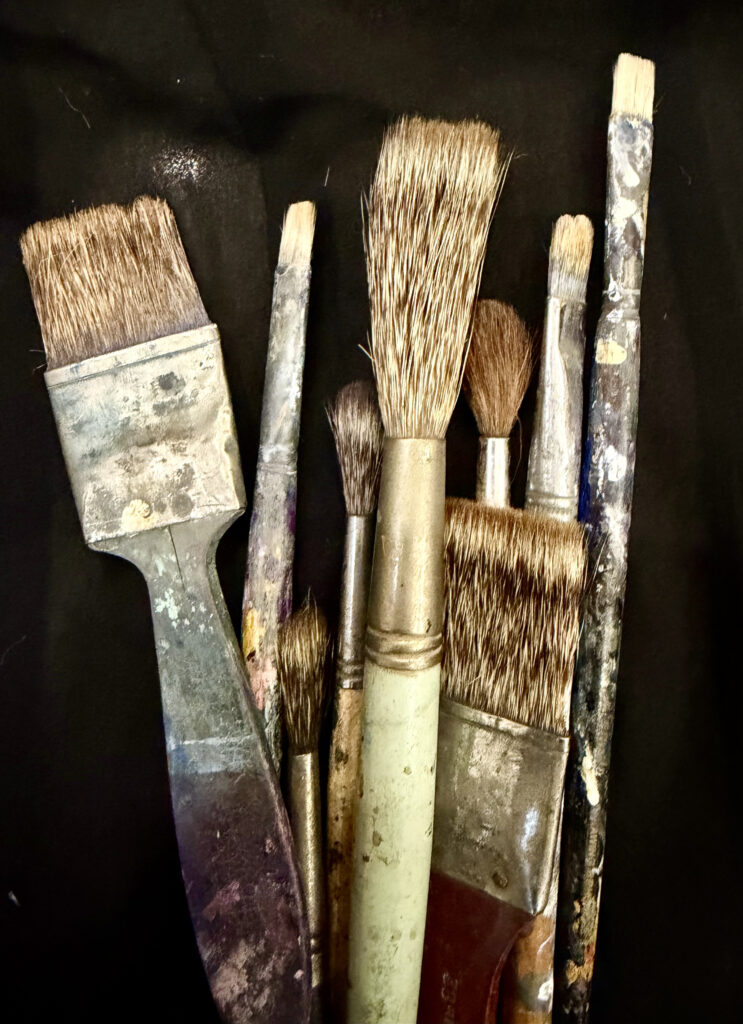
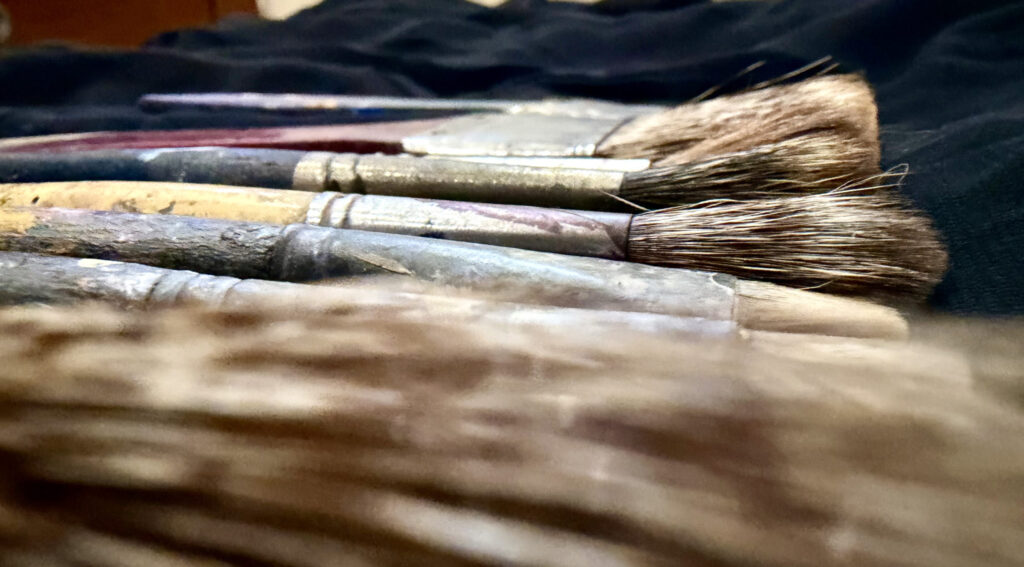
In the photograph, this gesture is already fully implied: the act of standing before the Somnath Temple is, as stated earlier, simultaneously the act of translating perception into line. The brush becomes a direct extension of that focused attention. Seen together, these objects do not function as separate tools, but rather as a continuous system of making. The palette holds accumulated decisions, the knife carries adjustment, the brushes extend gesture, and the watercolours contain the world as possibility. None of these elements are separate from the moment captured in the photograph; they are already deeply embedded within it.
What appears, then, is not simply a photograph of an artist at work, but a moment that brings together several histories: the Somnath Temple before its reconstruction, Bawa’s early practice as a painter, and the tools that would accompany him throughout his artistic life. Seen alongside his palette, paint knife and brushes, the photograph gives us a glimpse of how he looked at and translated the world around him. Together, these objects connect the young painter at Somnath with the artist he would become.