Taarkashi – Drawing matrilineal threads
Born in Saharanpur in 1901, amma was named Alice David at birth. It is difficult to say if she was an Anglo-Indian, but her mother, Angelica, had travelled from Germany to work for the East India Company.

Born in Saharanpur in 1901, amma was named Alice David at birth. It is difficult to say if she was an Anglo-Indian, but her mother, Angelica, had travelled from Germany to work for the East India Company.

The story of this ‘vari da baagh’ begins with bebeji. It was hand-embroidered in around 1965 and given to my dadi as part of her wedding trousseau. The baagh is made of red “khaddar” hand-dyed and hand-woven cloth.

This Majnu Khes, was brought over to East Punjab by my grandfather, Devinder Singh and his family, while they migrated from West Punjab, during Partition.

A farshi is a long voluminous garment that generously falls to the ground, and when standing or walking has a long train. The word farshi comes from ‘farsh’ or the ground/floor, which the garment trails on. This particular garment was carried from Panipat to Lahore and eventually to Sahiwal a few months after Partition.
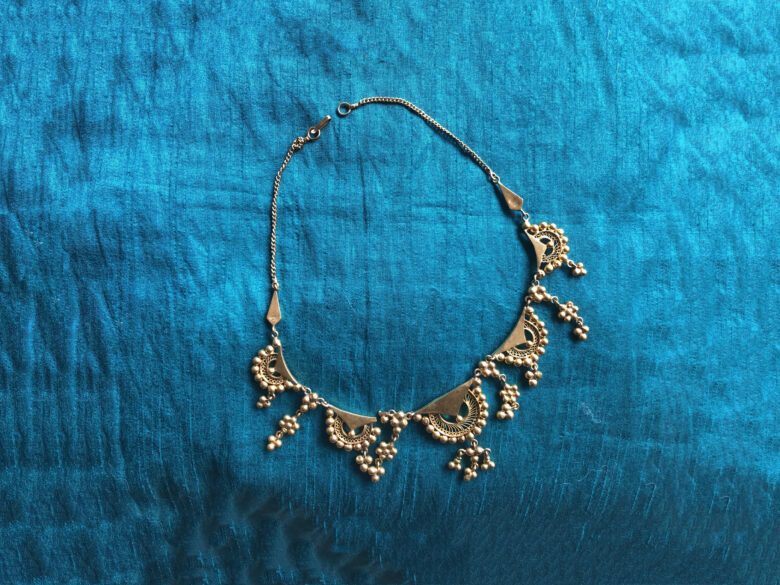
Kailash Marwah Nayyar would have been a new bride in 1947, only two years having passed to her marriage, when the family had to flee to India. Over the next few months, she sold her luxurious wedding trousseau piece by piece to help the family survive. This necklace is the only item that remains from it.