
TEXT AND PHOTOGRAPHS BY MANGAL KARNAD
Bengaluru, Karnataka, India
Some objects are just objects. Others carry the weight of kitchens, of mothers, of mornings that no longer exist except in the hearts that remember them. This traditional Indian spice box – widely used in kitchens across the subcontinent – is the second kind. Known generally as a masala dabba, it is designed to hold small quantities of commonly used spices in separate compartments within a single container. Most designs have seven small cavities arranged inside a larger circular or rectangular base, so that spices like cumin, coriander, mustard seeds, fenugreek, and others sit within easy reach of a cook who rarely has a free hand.
India’s relationship with spices is old, older than most written histories. References appear in the Rig Veda[1]. The masala box, in one form or another, evolved as the practical answer to a simple daily question: how do you keep everything within arm’s length of the flame? There were copper boxes too, but that is a story for another article.
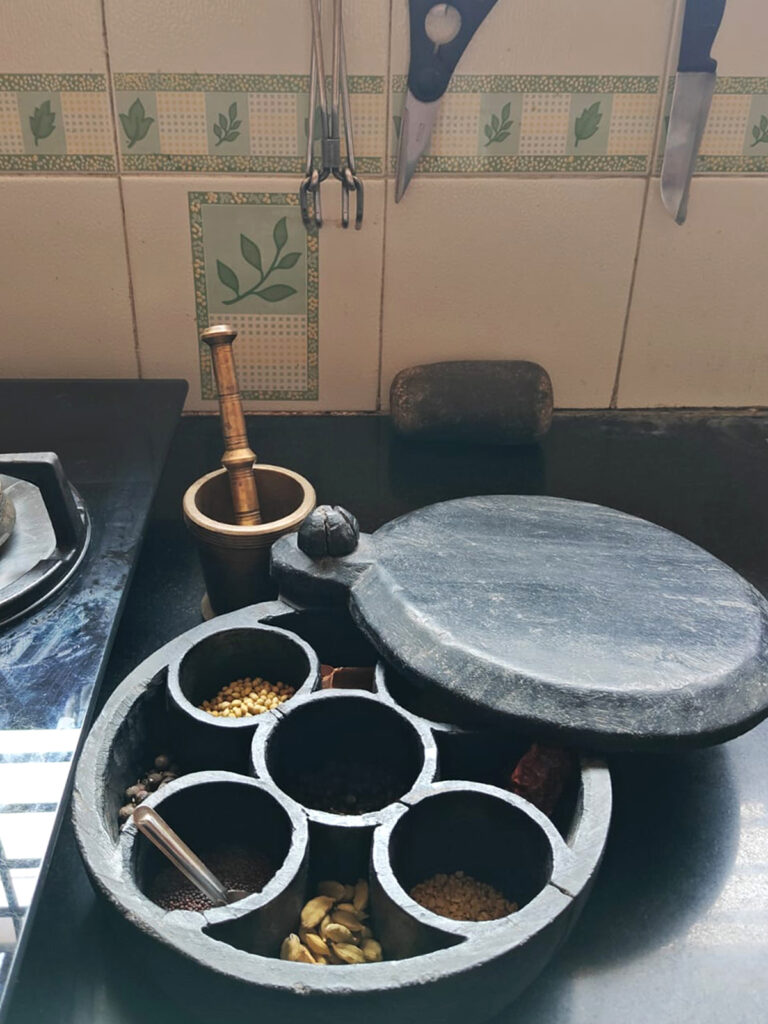
The Konkani Sambharḍe (or Sāmarḍe) is the regional wooden spice container from the western coast of India. It is carved from a single block of wood, with the compartments hollowed out one by one. The craftsmanship isn’t decorative; it’s structural. The wood has lasted for decades. The beauty of the box is that it breathes – it lets the spices stay dry without trapping moisture inside.
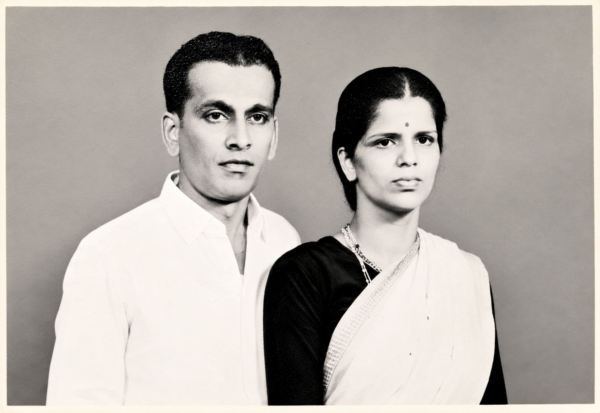
My mother, Shantha D Karnad, née Sarojini Cherkal, was married on the 19th of May, 1959, and came to Mulky from Manjeshwar. The Sambharḍe was already in the house when she arrived. And yet, in my memory, it belongs entirely to her as she was an amazing cook who had the patience and the skill to turn the simplest of ingredients into wonderful dishes.
Modern versions of the sambar box or container are usually stainless steel or plastic, neat, convenient, and easy to keep clean. But this Konkani Sambharḍe comes from my family home in Mulky, Karnataka, and it must be eighty or ninety years old. I remember watching my mother slide its lid open and pick her spices by eye, never measuring, never needing to. When I was a young girl, Amma would sometimes ask me to re-fill it, and that became a small ritual of its own – the turn of the wrist, the scrape of wood on wood, the spices waiting quietly in their own small wells.
She kept more spices in it than these photographs show. There was always Triphala, Ajwain, pepper, and a few dry red chillies, alongside the usual urad dal, fenugreek, coriander, cumin and mustard. The Sambharḍe carried the mixed smell of everything it had ever held; a warm, layered scent that was simply the smell of our kitchen.
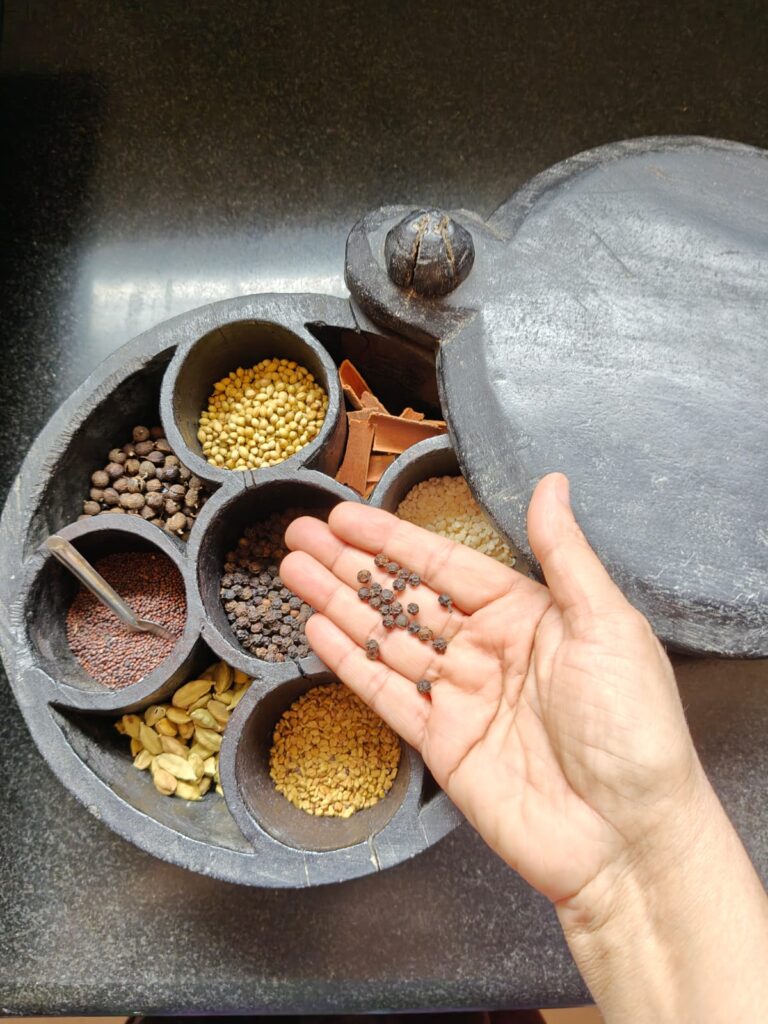
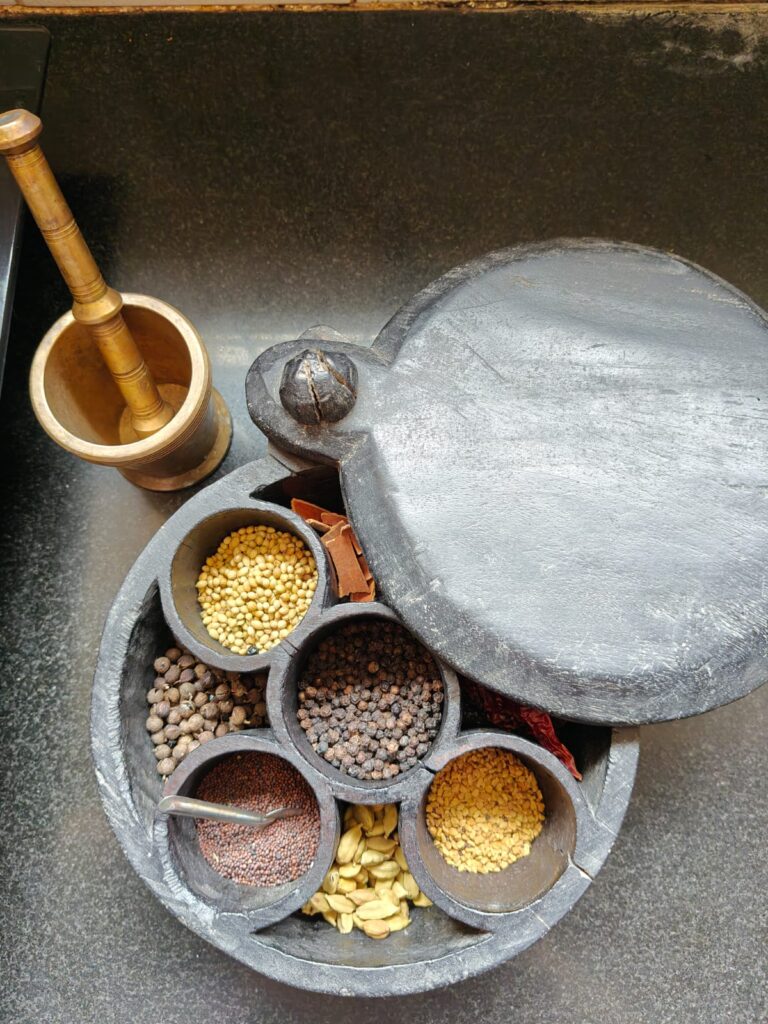
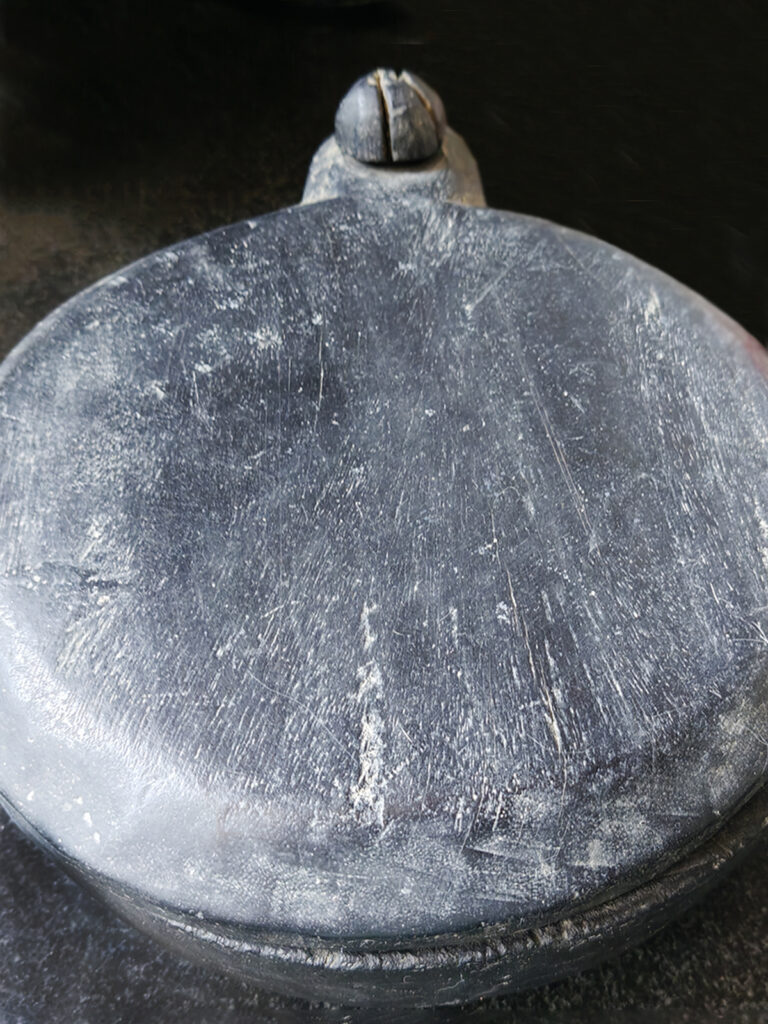
A few things set the Sambharḍe apart from the masala dabbas that most people know of today. It is hand-carved from a single block of wood, not assembled from parts. The compartments are integrated into the body itself, not removable steel cups. The matching wooden lid has a rotating mechanism, a small piece of ingenuity built into its design. The whole form suggests an older, artisanal style, very regional, possibly made to order. Here, function and craftsmanship held together in one piece of wood.
I’m not entirely sure of its origins. What I do know is that it is with me in Bangalore now. I brought it back because it was no longer being used in Mulky, and I worried it might get spoiled in a house where no one reached for it anymore. It is in very good condition, and it hasn’t been altered in any way, I’ve just had it gently polished to keep it safe.
I always remember it being black. Whether it was painted that way or simply darkened by decades of soot, I cannot say. Before the gas stove arrived, we cooked on the hearth in Mulky, and anything that lived in the kitchen eventually took on that patient, dark shine. Kitchens have a way of marking the things inside them.
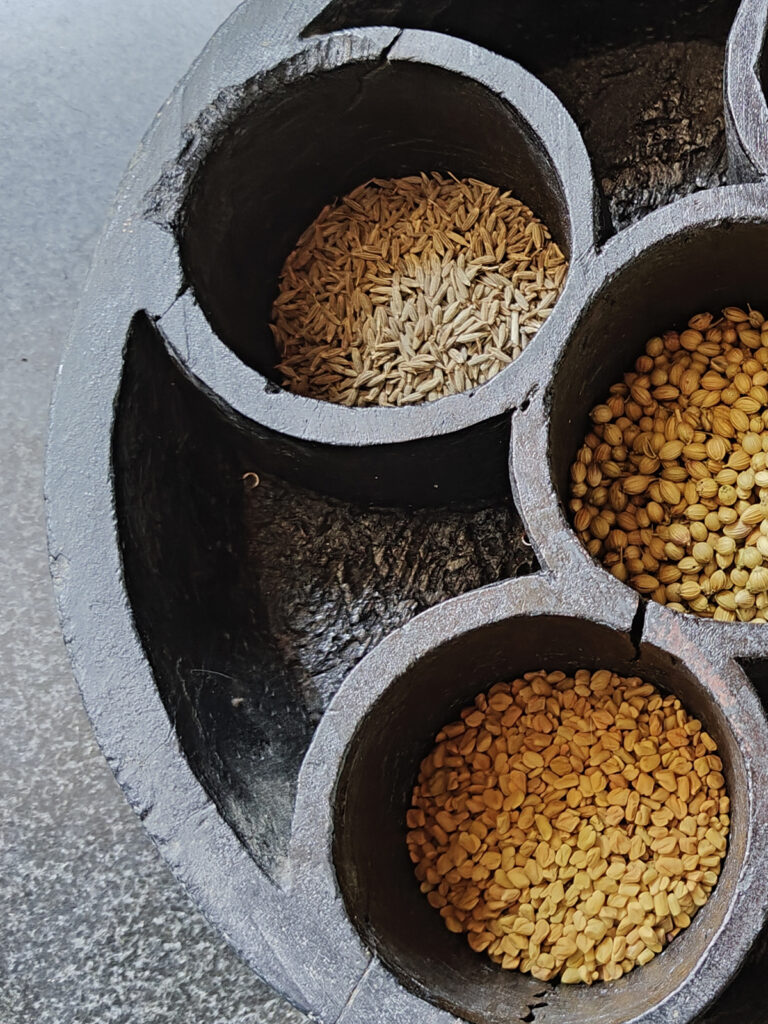
It is strange how something so ordinary becomes difficult to explain. To anyone else, the Sambharḍe is just a box with compartments, nothing more. But for me, it carries a way of doing things that was never written down. It was in the way Amma cooked, knowing how much to add, when to pause, how to bring everything together without measuring. That kind of understanding and instinct does not sit in recipes. It came from habit, from years of doing the same thing with care. In some quiet way, it feels like that still rests in this wood. Keeping it close does not recreate that knowledge, but it keeps me connected to it, in a way that feels familiar.
These days, the Sambharḍe holds my silver jewellery, though it was never meant for such a thing. It doesn’t seem to mind. For me, it is one of the objects from my childhood that brings back memories of the big airy kitchen in Mulky, and Amma, unhurried at the stove, her hand moving from one compartment to the next without a second’s thought, seasoning the day’s healthy, wholesome meals into shape.
[1] ‘Plants have been used to treat or prevent illness since before recorded history. The sacred Vedas dating back between 3500 B.C and 800 B.C give many references of medicinal plants. One of the remotest works in traditional herbal medicine is “Virikshayurveda”, compiled even before the beginning of Christian era. “Rig Veda”, one of the oldest available literatures written around 2000 B.C. mentions the use of Cinnamon (Cinnamomum verum), Ginger (Zingiber officinale), Sandalwood (Santalum album) etc. not only in religious ceremonies but also in medical preparation’, Vijayakumar, A., Duraipandiyan, V., Jeyaraj, B., Agastian, P., Karunai Raj, M., and Ignacimuthu, S., Phytochemical analysis and in vitro antimicrobial activity of Illicium griffithii Hook. f. & Thoms extracts, Asian Pacific Journal of Tropical Disease, pp. 190-199, 2012.
“The Sambharde from Mulky” is a tender and beautifully written reflection on memory, motherhood, and the emotional lives of everyday objects. Through an old, hand-carved wooden spice box, Mangal Karnad brings alive a vanished kitchen in Mulky, filled with the fragrance of spices, the warmth of the hearth, and the comforting presence of her mother, Shantha. The article’s strength lies in its quiet simplicity, showing how years of touch, habit, and care can transform an ordinary household object into a deeply personal family archive.
The Sambharde also stands as a reminder of regional craftsmanship and a slower way of life that modern convenience has gradually replaced. Though it now holds silver jewellery instead of spices, it continues to preserve something precious. This moving article reminds us that family history does not always survive in photographs or documents; sometimes, it lives in the worn wood of a familiar object, carrying the scent of another time and the memory of a mother’s instinctive love.